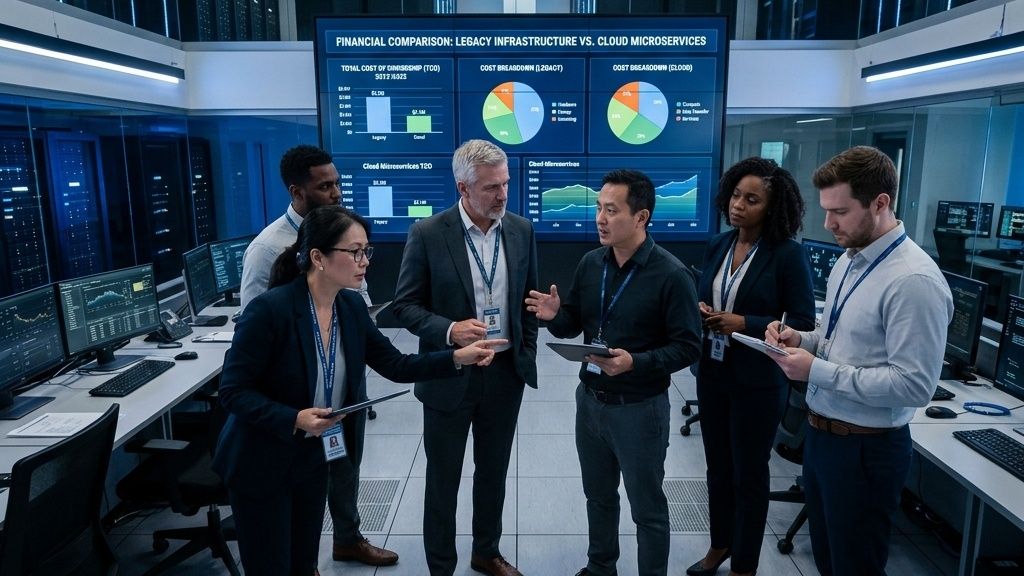
Your 12-year-old ERP system runs on PHP 5.6 — a framework that lost official security support in December 2018. Every month, your IT team patches it like a surgeon keeping a patient alive on a ventilator. Not because the patient will recover, but because nobody has approved pulling the plug. Meanwhile, the maintenance bill silently consumes €180,000 per year, every new feature request takes 4x longer than it would on a modern stack, and two of your best engineers have resigned in the past six months because they refuse to spend another year debugging a framework the rest of the industry abandoned half a decade ago.
This is not a technology problem. This is a financial problem — one that compounds quarterly and hides behind line items that no single department owns.
Legacy systems do not announce their true cost. They bleed companies slowly, through channels that never appear on the same spreadsheet. And in 2026, the gap between legacy maintenance costs and modern-system TCO has widened further — driven by tighter EU compliance requirements (DORA, NIS2), accelerating cloud-native ecosystem maturity, and an engineering talent market that increasingly treats legacy stacks as career poison.
This article provides the complete cost framework: six hidden cost layers most companies miss, a realistic 3-year TCO comparison, the three migration strategies with decision criteria for each, a real-world case study, and the exact CFO pitch structure that gets legacy modernisation funded.
The Hidden Cost Layers of Legacy Software
Most companies track only the obvious maintenance costs — developer salaries and hosting fees that appear on the IT budget. The real expense hides in six layers, and when quantified together, they typically reveal that the “affordable maintenance” option costs 2.8–3.4x more than building new.
Layer 1: Direct Maintenance Cost — The Visible Line Item
This is what your CFO sees: developer salaries allocated to legacy maintenance, hosting and infrastructure costs, vendor support contracts, and license renewal fees for deprecated software.
The benchmark is damning. According to the 2025 McKinsey Digital report, companies spend an average of 60–80% of their IT budget maintaining existing systems, leaving only 20–40% for innovation. For a European mid-market company with a €2 million annual IT budget, that means €1.2–1.6 million per year goes to keeping the lights on — not to building anything new.
Direct maintenance for a mid-complexity legacy system (50,000–150,000 lines of code, 3–5 integrations, 500–2,000 active users) typically runs €150,000–€220,000 per year when you include:
- 2–3 dedicated engineers at €65,000–€85,000 loaded cost each (Western Europe)
- Legacy-specific hosting at €1,500–€3,000/month (on-premise servers or aged cloud VMs that nobody dares to migrate)
- Vendor support contracts at €15,000–€40,000/year for deprecated database engines, middleware, or operating systems
- Emergency patches and hotfixes that average 12–18 incidents per year, each consuming 8–24 developer-hours
Layer 2: Opportunity Cost of Developer Time — The Invisible Tax
Every hour a senior developer spends debugging a legacy system is an hour they are not building features that generate revenue. This is not theoretical — it is measurable.
If your four best engineers spend 50% of their time on legacy maintenance, that is equivalent to losing two full-time engineers from your product team. At a fully loaded cost of €90,000 per engineer per year, that is €180,000 in annual productivity permanently diverted from revenue-generating work.
The velocity multiplier makes it worse. Modern frameworks like Next.js, Laravel 11, or Spring Boot 3 enable 2–4x faster feature development compared to legacy stacks (Classic ASP, PHP 5.x, jQuery + spaghetti backends). A feature that takes 2 weeks on a modern stack takes 6–8 weeks on the legacy system — not because the feature is harder, but because the developer must navigate undocumented dependencies, work around deprecated APIs, and manually test integrations that modern frameworks handle automatically.
Over three years, the opportunity cost of keeping engineers on legacy maintenance instead of shipping revenue features typically exceeds the direct maintenance cost itself.
Layer 3: Security Vulnerability Exposure — The Time Bomb
Unpatched frameworks, deprecated libraries, and outdated encryption standards create attack surfaces that grow wider every month. The risk is not hypothetical — it is actuarial.
Key data points:
- The average cost of a data breach in the EU reached €4.3 million in 2025 (IBM Cost of a Data Breach Report)
- Systems running end-of-life (EOL) software experience 3x more security incidents than current-version systems (Flexera 2025 State of IT Visibility Report)
- 67% of exploited vulnerabilities target known, unpatched CVEs — meaning attacks that would have been prevented by keeping software current (Verizon 2025 Data Breach Investigations Report)
Legacy systems with known, unpatched CVEs are not just “risky” — they are essentially open invitations with a calculable probability of breach. For a mid-market European company processing personal data, the actuarial security cost (probability × impact) of running an EOL system is €100,000–€250,000 per year.
And insurance is catching the up. Cyber insurance premiums for companies running EOL software have increased 40–60% since 2024, with some underwriters refusing coverage entirely for systems on unsupported frameworks.
Layer 4: Integration Friction — The Middleware Tax
Modern SaaS tools, APIs, and cloud services expect modern authentication protocols (OAuth 2.0, OIDC), modern data formats (JSON, GraphQL), and modern deployment patterns (containerised, stateless). Legacy systems speak none of these languages.
Every new integration requires custom middleware — a translation layer that converts between the legacy system’s SOAP/XML/FTP interfaces and the modern world’s REST/JSON/webhook patterns. Each middleware layer costs €15,000–€40,000 to build, €5,000–€10,000 per year to maintain, and introduces a new failure point.
The compound effect is devastating. A typical legacy system accumulates 5–10 middleware layers over 3–5 years. Each layer adds latency, reduces reliability, and creates a maintenance burden that grows exponentially as middleware versions themselves become outdated. By year five, the middleware stack can cost more to maintain than the legacy system it serves.
Real-world integration friction examples:
- CRM integration (Salesforce/HubSpot): Legacy system exports CSV nightly → middleware parses and maps fields → API calls push to CRM. 12-hour data lag, 3% error rate on field mapping.
- Payment gateway (Stripe/Adyen): Legacy checkout cannot handle webhooks → middleware polls the payment provider every 5 minutes → order status updates lag behind actual transactions.
- Analytics platform (Google Analytics 4 / Snowflake): Legacy system has no event emission capability → server log scraping middleware estimates user behaviour from access logs. Data accuracy: ~60%.
Layer 5: Talent Attrition — The Hiring Death Spiral
Talented developers refuse to work on COBOL, Classic ASP, PHP 5.x, or jQuery-era frontend stacks. The engineering labour market in 2026 is clear about this: developers choose employers based on technology stack, and legacy stacks are career poison.
The financial impact manifests in three ways:
-
Legacy specialist premium. Finding developers willing to work on EOL stacks requires paying a 30–50% salary premium. A PHP 5.x specialist in the Netherlands commands €85,000–€95,000 — compared to €65,000–€75,000 for a mid-senior PHP 8.x or Node.js developer doing equivalent work on a modern stack.
-
Attrition cost. Replacing a departed developer costs 50–100% of their annual salary (recruitment fees, onboarding time, lost productivity during ramp-up). If your legacy team turns over every 18–24 months — which is typical for developers stuck on deprecated stacks — you are spending €40,000–€85,000 per departure.
-
The quality spiral. As your best engineers leave, the remaining team becomes less capable of maintaining the legacy system safely. This leads to more bugs, more hotfixes, more overtime, which accelerates further attrition. The team that inherits the legacy system is progressively less qualified to maintain it.
Layer 6: Compliance Creep — The Regulatory Ratchet
European regulations tighten annually: GDPR (ongoing enforcement), DORA (Digital Operational Resilience Act — financial sector, effective January 2025), NIS2 (network and information security, effective October 2024), and the EU AI Act (August 2025). Each new regulation adds compliance requirements that legacy systems were never designed to meet.
Proving compliance on a system with no audit trail, no role-based access control, no encryption-at-rest, and no automated logging requires manual documentation — hundreds of hours of staff time writing policies that describe how a system should behave, rather than how it actually behaves, because the system lacks the observability to prove compliance automatically.
Concrete compliance costs on legacy systems:
The Full TCO Comparison: Legacy vs. Rewrite Over 3 Years
Here is a realistic side-by-side for a mid-complexity enterprise system (80,000 LOC, 5 integrations, 1,500 active users, running on PHP 5.6 / MySQL 5.5 / jQuery frontend):
The legacy system costs 2.8x more over three years. And this is conservative — the model does not account for:
- Revenue lost because new features took 4x longer to ship (competitive disadvantage)
- The compounding effect of further talent attrition in years 2 and 3
- A potential security breach (which would add €1–4.3 million in a single event)
- Increasing cyber insurance premiums for EOL software
Martin Fowler defines the core issue precisely: “Legacy code is code without tests. But more importantly, legacy code is code that actively resists change.” The financial consequence of that resistance is what the table above quantifies.
The Decision Framework: When to Rewrite, When to Wrap, When to Strangle
Not every legacy system should be rewritten. The right modernisation strategy depends on system complexity, business criticality, and organisational capacity for change. Three strategies exist, each suited to different situations.
Strategy 1: Full Rewrite — The Clean Slate
When it is right: The legacy system is fundamentally architecturally broken — monolithic, untestable, and the business requirements have changed so dramatically that the existing system cannot be incrementally adapted. The system has fewer than 100,000 lines of code, and requirements for the new system are well-documented.
When it is wrong: The existing system works and generates revenue without major issues. Requirements for the new system are unclear. The organisation plans to rewrite AND change the business model simultaneously (never do both at once). The system exceeds 200,000 LOC — the rewrite will take longer than estimated, guaranteed.
The cautionary tale: The infamous Netscape rewrite — which took three years and nearly killed the company — remains the definitive warning. Joel Spolsky called it “the single worst strategic mistake that any software company can make.” The rewrite team underestimated the accumulated business logic embedded in “ugly” code, and by the time the new version shipped, the competitive landscape had moved on.
Risk mitigation if you proceed: Time-box the rewrite to 12 months maximum. If it is not production-ready in 12 months, switch to the Strangler Fig approach for remaining modules. Document all business rules from the legacy system before writing a single line of new code.
Strategy 2: API Wrapping — The Façade Approach
When it is right: The legacy backend is stable and functional, but the frontend, integrations, and user experience are the problem. The core business logic in the legacy system is correct — it just needs a modern interface.
How it works: Build a modern API layer (REST or GraphQL) around the legacy system. The API translates between modern protocols and the legacy system’s internal interfaces. New frontends (React, Vue.js) and integrations (webhooks, OAuth) connect to the API layer, never directly to the legacy system.
Benefits: No changes to the legacy backend. Modern frontend and integrations within 3–6 months. The API layer becomes the foundation for future incremental replacement of backend modules.
Cost: Typically 30–40% of a full rewrite cost — €80,000–€120,000 for a mid-complexity system.
Strategy 3: The Strangler Fig Pattern — The Safe Migration
For systems too large and risky to rewrite in one shot, the Strangler Fig Pattern — named by Martin Fowler after the tropical fig that gradually envelops its host tree — provides the safest migration path:
- Identify one module of the legacy system (e.g., user authentication)
- Build the replacement as an independent service on a modern stack
- Route traffic to the new module while the old one runs in parallel
- Verify parity — compare outputs between old and new for 2–4 weeks
- Decommission the old module once parity is confirmed
- Repeat for the next module, moving from lowest-risk to highest-risk
Why it works: Each module replacement is a self-contained project with measurable outcomes. If a replacement fails, only that module is affected — the rest of the system continues running. Value delivery starts from week 6–8, not month 14.
Typical timeline: 8–18 months for full migration, with the first module live within 6–10 weeks.
The decision matrix:
Real Example: A Dutch Logistics Company Modernises a 15-Year-Old WMS
How a Rotterdam-based 3PL replaced their legacy warehouse management system without losing a single shipment
A mid-market third-party logistics (3PL) provider in Rotterdam operated a custom warehouse management system (WMS) built in 2011 on PHP 5.4, MySQL 5.1, and a jQuery 1.x frontend. The system processed 4,000 daily orders across three warehouses, managed 85,000 SKUs, and generated €28 million in annual revenue.
The breaking point: In Q3 2025, the company signed a new enterprise client requiring real-time API integration for inventory visibility. The legacy WMS had no API — inventory updates were transmitted via nightly CSV exports. The integration team estimated 14 weeks and €95,000 to build a custom middleware layer for this single client. The CTO calculated that similar middleware requests would recur 3–4 times annually as more enterprise clients demanded real-time data.
The decision: Rather than build another middleware layer, the CTO chose a Strangler Fig migration. The scope: replace the WMS module-by-module over 12 months, starting with the inventory and API module (the most urgent business need), and ending with the picking and packing workflow (the most complex and highest-risk module).
The execution:
- Months 1–3: New inventory service (Node.js + PostgreSQL) with a REST API. The legacy system continued to operate internally; the new service consumed the same MySQL database via read replicas, exposing real-time data through API endpoints. The enterprise client integration went live in week 10.
- Months 4–6: Order management and shipping label generation migrated to the new stack. The legacy system’s order flow was rerouted through the new services while the legacy frontend continued displaying data from the new backend.
- Months 7–10: Picking and packing workflows replaced. This was the highest-risk module — any error would halt physical warehouse operations. The team ran both systems in parallel for 4 weeks, comparing outputs on every pick instruction. Discrepancy rate: 0.02% (8 out of 42,000 instructions), all traced to a timezone formatting bug in date calculations.
- Months 11–12: Frontend replacement (React) and legacy system decommission.
Result: Total migration cost: €310,000. The company eliminated €185,000/year in legacy maintenance, reduced new-feature development time by 65%, and onboarded 3 new enterprise API clients within 60 days of the API going live — generating €1.8 million in incremental annual revenue.
Cost & Timeline: 12 months, €310,000 total. Break-even against legacy maintenance costs at month 20. Positive ROI of €720,000 by end of year 3.
How to Build the Business Case for Your CFO
CFOs respond to numbers, not architecture diagrams. Structure your legacy modernisation pitch using the following framework:
Slide 1: Current annual legacy maintenance spend Include all six cost layers. Most CFOs have only seen Layer 1 (direct maintenance). Quantifying layers 2–6 is where the “aha moment” happens. Use the benchmarks from this article as starting points, then replace them with your company’s actual numbers.
Slide 2: Projected 3-year TCO comparison Present the side-by-side table (legacy vs. rewrite/migration). The 2.8x multiplier is the headline number. Frame it as: “We will spend €1.5 million over three years to maintain a system that generates the same output a €545,000 modern system would produce. That is €990,000 in avoidable cost.”
Slide 3: Revenue acceleration from faster feature delivery Quantify the competitive cost of slow delivery. If your product team’s velocity is 4x slower on the legacy stack, calculate the revenue impact: “Each month of delayed feature delivery costs us €X in lost deals / delayed client onboarding / competitive positioning.”
Slide 4: Risk reduction Present the actuarial security cost, the insurance premium trajectory, and the compliance gap. DORA and NIS2 have introduced personal liability for board members in cases of inadequate ICT risk management — this gets executive attention.
Slide 5: Migration timeline with Strangler Fig approach Show incremental value delivery. The CFO’s biggest fear is a multi-year “big bang” project that delivers no value until month 18. The Strangler Fig approach delivers the first production module in 6–10 weeks, reducing ongoing costs from day one.
Slide 6: Vendor and team structure Present the blended team model: Amsterdam-based project governance (PM, architect, QA lead) with Ho Chi Minh City engineering capacity (4–6 developers). This gives European control standards with Vietnamese development velocity — quality assured, cost-optimised. Manifera’s custom software development team has executed this model for Dutch and European enterprises consistently.
Get a custom team proposal within 48 hours — contact us at manifera.com/contact-us.
FAQs
How long does a typical legacy system modernisation take, and when do we start seeing ROI?
For a Strangler Fig migration, expect 8–18 months for full migration depending on system complexity and the number of modules. Each individual module replacement takes 6–12 weeks. The critical advantage over a full rewrite is that ROI begins almost immediately: the first migrated module reduces maintenance overhead from week 8–10. For a complete rewrite of a mid-complexity system (under 100,000 lines of code), expect 8–14 months. Break-even against legacy maintenance costs typically occurs at month 18–24 — meaning the rewrite pays for itself within two years through eliminated maintenance spend alone, before counting revenue acceleration or risk reduction.
Can we modernise a legacy system without rewriting it entirely, and which approach is right for us?
Yes — three distinct approaches exist, each suited to different situations. (1) API Wrapping — build a modern REST/GraphQL API layer around the legacy backend, enabling modern frontends, mobile apps, and third-party integrations without touching the core system. Best when the backend logic is sound but the interface and integration layer is the problem. Cost: 30–40% of a full rewrite. (2) Strangler Fig Pattern — replace individual modules incrementally while both systems run in parallel. Best for complex systems over 100,000 LOC where a full rewrite is too risky. (3) Lift-and-shift to cloud — containerise the existing application and deploy on modern cloud infrastructure (AWS, Azure EU regions), gaining scalability and monitoring benefits without code changes. Best as a stopgap to reduce hosting costs while planning a deeper modernisation.
What happens to our data during migration, and how do we ensure GDPR compliance throughout?
Data migration follows a strict protocol: extract from legacy database, transform to new schema (including data type normalisation and referential integrity checks), load into the modern database, and validate integrity through automated comparison scripts that check record counts, checksums, and business rule consistency. The legacy system runs in parallel until validation is complete — zero data loss, zero downtime. For GDPR-regulated data, migration plans must include: a comprehensive data mapping exercise (Article 30 Records of Processing Activities update), a Data Protection Impact Assessment (DPIA) if the processing scope, technology, or third-party access changes, explicit documentation of any cross-border data transfers, and validation that Right to Erasure (Article 17) and Data Portability (Article 20) capabilities function correctly in the new system before legacy decommission.
How do we maintain business continuity during migration without disrupting operations or losing customers?
The Strangler Fig approach specifically addresses continuity: both systems run simultaneously during the entire migration period. A routing layer (typically an API gateway or reverse proxy) directs requests to either the legacy or modern system depending on which modules have been migrated. End users interact with a single URL and experience no “switch-over” moment. For critical modules (e.g., order processing, payments, inventory management), a parallel validation period of 2–4 weeks runs both old and new systems simultaneously, comparing outputs instruction-by-instruction. Only when the discrepancy rate drops below 0.05% is the legacy module decommissioned. This approach has been used successfully for high-availability systems processing thousands of daily transactions with zero customer-visible disruption.
What technology stack should we migrate TO in 2026, and how do we avoid repeating the same mistake in 10 years?
Avoid chasing trends. Choose technologies with large ecosystems, strong hiring pools, proven enterprise adoption, and active long-term support commitments. The 2026 “boring technology” stack that maximises longevity: Frontend — React 19 or Vue.js 3 (massive community, corporate backing, abundant talent). Backend — Node.js 22 LTS or Laravel 11 for web-centric applications; Spring Boot 3 for enterprise Java shops. Database — PostgreSQL 17 for relational data (most advanced open-source RDBMS); Redis for caching. Infrastructure — Docker + Kubernetes on AWS (EU regions) or Azure (Amsterdam/Frankfurt regions) for EU data residency. API — REST with OpenAPI spec for external APIs; GraphQL for complex internal data queries. To avoid repeating the mistake: enforce automated testing (minimum 80% coverage on critical paths), maintain continuous dependency updates (Dependabot/Renovate), document architecture decisions (ADRs), and allocate 15–20% of every sprint to technical debt reduction. Manifera’s technology recommendations are specifically chosen for 10+ year longevity and maintainability — contact our Amsterdam team to discuss your stack at manifera.com/contact-us.
Suggested Posts





How useful was this post?
Share it with your friends


Get our latest articles here!
Thank you for subscribing to our blog!
Do you have any questions?
Help us improve the content of this Insightful blog by asking us questions. Manifera's team of experts will help you answer these questions as soon as possible.