
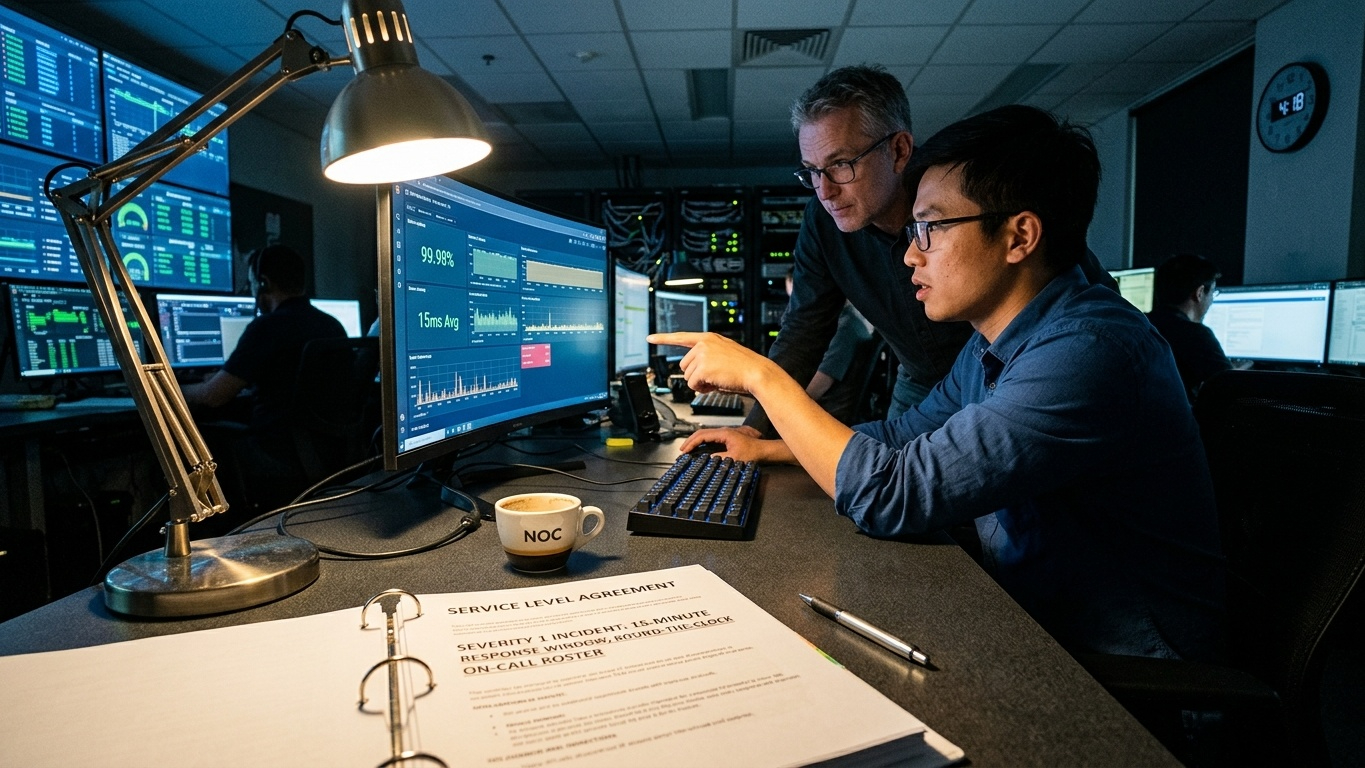
Last quarter, an IT manager at a mid-sized logistics company came to us with a signed maintenance contract from a previous web software development vendor and a production outage that had lasted eleven hours. The SLA on file promised “priority response within 4 hours.” What it didn’t specify was that the 4-hour clock only started once a ticket was formally triaged as “critical” by the vendor’s own support team — and triage, buried three pages later in a document nobody had read past the summary page, was allowed up to 24 hours. The contract wasn’t dishonest. It was just written by someone whose job was to protect the vendor, reviewed by someone on the client side who was optimizing for signing quickly, not for reading carefully. That gap cost the client a full day of degraded operations on a system their warehouse floor depended on hourly.
This happens constantly, and it happens because maintenance SLAs are the least glamorous document in the entire vendor selection process. Everyone reads the proposal. Almost nobody reads the SLA line by line before signing, which is exactly backwards, because the SLA is the document that governs what happens the day something actually breaks — the day the proposal’s promises stop mattering and the contract’s fine print becomes the only thing standing between you and extended downtime.
If you’re currently comparing final-round web software development vendors, this is likely the single most consequential document you haven’t read carefully yet, and it’s worth setting aside a dedicated hour with it before you sign anything, ideally with the actual person who will be paged during an outage in the room.
Why the SLA Deserves More Scrutiny Than the Proposal
A vendor proposal describes the best-case scenario: on-time delivery, smooth communication, a working product. An SLA describes the worst-case scenario: what happens when a critical bug ships to production, when a security patch needs emergency deployment, when the assigned engineer is unavailable during an incident. You’re comparing web software development vendors precisely because you expect the best case to look similar across your finalists — competent teams generally deliver competent software. Where finalists actually diverge, in ways that matter to your budget and your operational risk, is in how they’ve structured the worst case. That’s entirely captured in the SLA, and it’s exactly the document most buyers skim.
Breaking Down What a Real Maintenance Budget Looks Like
To read an SLA critically, you need a realistic sense of what maintenance actually costs, because vague or bundled pricing is one of the easiest places for terms to hide unfavorable conditions. For a mid-complexity web application serving a few thousand active users, a reasonable annual maintenance budget typically breaks down as follows:
- Bug fixes and minor updates: €800-€1,500 per month for a retainer covering routine fixes, dependency updates, and small enhancements, assuming 10-20 hours of monthly capacity.
- Security patching and monitoring: €300-€600 per month for proactive vulnerability scanning, dependency audits, and patch application — often bundled into the retainer but sometimes billed separately, which is worth clarifying explicitly.
- Emergency incident response: Typically billed at a premium rate 1.5x to 2x the standard hourly rate for after-hours or weekend critical fixes, since this is genuinely disruptive, unplanned work for the vendor’s team.
- Infrastructure and hosting oversight: €200-€500 per month if the vendor also manages your cloud infrastructure, separate from application-level maintenance.
Total annual maintenance for a mid-complexity application commonly lands between €13,000 and €28,000, though this varies significantly with application complexity, traffic, and how much of the infrastructure stack the vendor is responsible for. If a vendor’s quote falls dramatically below this range, the SLA is the place to find out what’s been cut to hit that number — usually response time guarantees, patch frequency, or included hours.
The SLA Clauses That Actually Determine Your Risk
Response time versus resolution time. These are not the same commitment, and vendors sometimes present them interchangeably in sales conversations while keeping them distinct in the contract. Response time is how quickly someone acknowledges your ticket; resolution time is how quickly the problem is actually fixed. A 1-hour response time commitment paired with no resolution time commitment at all means you can get a fast “we’re looking into it” email and then wait days for an actual fix, technically without the vendor breaching anything.
How “critical” gets defined and who decides. As in the logistics company example above, many SLAs give the vendor sole discretion over severity classification, which creates an obvious conflict of interest during an actual incident — the vendor’s team is incentivized to classify issues at a lower severity to avoid triggering penalty clauses. Push for a jointly agreed severity matrix defined in the contract itself, with concrete criteria (e.g., “critical = production system fully unavailable or data integrity at risk”), not vendor discretion applied after the fact.
Included hours versus overage billing. Retainer-based maintenance contracts typically include a fixed number of monthly hours, with overage billed at an hourly rate that’s sometimes higher than your original development rate. Ask explicitly what happens in a month with an unusual spike in maintenance need — a security incident, a third-party API breaking change — and whether that spike is covered under emergency response terms or billed as standard overage at a rate that could be a significant surprise on your next invoice.
Penalty and credit clauses. A genuinely well-structured SLA includes service credits or fee reductions if the vendor misses committed response or resolution times — not just an apology. If a vendor’s SLA has response time commitments but no consequence for missing them, the commitment is aspirational rather than contractual, and you should treat it as a marketing statement rather than a guarantee when comparing finalists.
Termination and transition clauses. Read what happens if you want to leave. A fair SLA includes a defined transition period, a commitment to hand over documentation and access credentials promptly, and no punitive exit fees beyond a reasonable notice period. Vendors who make transitions deliberately painful are signaling, indirectly, that they’re aware their retention depends on switching costs rather than ongoing satisfaction.
A Worked Example: Two Quotes That Looked Identical
Consider two SLA proposals an IT manager might receive for maintaining the same internal MNC portal. Vendor A quotes €1,400 per month, includes 20 hours, promises “priority support,” and lists a 2-hour response time. Vendor B quotes €1,800 per month, includes 18 hours, and lists a 4-hour response time with an explicit 24-hour resolution commitment for critical issues, a jointly defined severity matrix, and a 15% fee credit for any month a critical resolution target is missed. On the summary page, Vendor A looks like the better deal — faster response, lower price, more included hours. Read the full SLA, though, and Vendor A’s “priority support” turns out to have no defined resolution commitment at all, and severity classification is left entirely to Vendor A’s discretion. Vendor B’s slower headline response time comes with an actual enforceable guarantee about when the problem gets solved, not just acknowledged, backed by a financial consequence if they miss it.
For a system that genuinely matters to daily operations, Vendor B’s structure is very often worth the extra €400 a month, because the real cost of an SLA isn’t the retainer fee — it’s the expected cost of downtime multiplied by the probability that a vague commitment leaves you exposed during an actual incident. If your production system going down for a business day costs anywhere near what it typically does for an MNC-scale operation, the retainer difference between these two vendors is close to a rounding error by comparison.
Compliance and Documentation Requirements Worth Adding to the SLA
For IT managers operating under GDPR or working toward SOC 2 alignment, the maintenance SLA is also where data handling commitments during support work need to be explicit, not assumed. Ask whether the vendor’s support team accesses production data directly when debugging an issue, and if so, what access controls, logging, and data minimization practices apply. Ask whether patch and update activity is documented in a way that would satisfy an audit — a simple changelog is not the same as an audit-ready record showing who approved a change, when it was deployed, and what testing preceded it. Vendors serving MNC clients regularly should have ready answers to both questions; vendors who haven’t previously worked with compliance-sensitive clients often need to build this documentation discipline specifically for you, which is a fair thing to request but should be priced and time-boxed explicitly in the SLA rather than left as an assumed, unbilled extra.
Comparing Three Real SLA Structures
When you lay finalist SLAs side by side, the differences tend to cluster into three patterns. The first is the “generous headline, vague fine print” structure — an impressive 1-hour response time commitment upfront, undermined by discretionary severity classification and no resolution time guarantee, which usually indicates a sales-driven document rather than an operations-driven one. The second is the “conservative but honest” structure — a 4-hour response time with clear resolution targets by severity tier and jointly defined severity criteria, which is less flashy in a sales deck but considerably more useful during an actual incident. The third is the “all-inclusive premium” structure — tight response and resolution commitments bundled with a higher retainer, appropriate for mission-critical systems where downtime cost genuinely justifies the premium, but potentially overpriced for a lower-stakes internal tool. None of these three is universally correct; the right one depends on what an hour of downtime actually costs your business, which is a number worth calculating honestly before you compare quotes.
How Manifera Structures Maintenance SLAs
Communication excellence is central to how we handle this, in practice and not just as a stated value: our support engineers are English-fluent and work with overlapping hours to Central European Time, so a critical ticket raised by an IT manager in the EU during business hours reaches someone who can act immediately rather than waiting on a handoff across a large timezone gap. We also build genuine flexibility into our offshore software development engagements — retainer hours can scale up or down within 2-4 weeks as your actual maintenance needs shift, rather than locking you into a fixed monthly commitment sized for a worst case that may never materialize, or worse, a best case that leaves you underprovisioned during a real incident.
For clients evaluating a maintenance relationship alongside active web app development, we walk through the severity matrix and resolution commitments explicitly during the proposal stage — before signing, not after the first incident forces the conversation. If you’re setting up an offshore relationship for the first time, our guide on setting up your offshore team covers how SLA terms typically get negotiated during onboarding, which is useful context even if you ultimately choose a different partner.
What to Do Before You Sign
Take the SLA document from every finalist and build a simple comparison table with five rows: response time by severity tier, resolution time by severity tier, who defines severity, included hours and overage rate, and penalty clauses for missed commitments. Fill it in using the vendor’s actual contract language, not their sales summary of it. This exercise alone typically surfaces the meaningful differences between finalists that look nearly identical on price and take considerably less time than the eleven-hour outage it’s designed to prevent.
It’s worth involving whoever owns incident response on your side — not just procurement — in this comparison, since they’re the person who will actually be on the phone with the vendor during a real outage, reading the SLA in a moment of genuine stress rather than calm evaluation. Their perspective on which clauses matter most in practice is often sharper than a purely contractual read, and it costs nothing to include them before the contract is finalized rather than after the first incident makes the gaps obvious to everyone.
Download our ROI calculator for offshore development and stress-test your shortlisted vendor’s numbers against a realistic maintenance budget before you sign anything.
FAQs
What is a reasonable maintenance SLA response time for web software development?
For most production business applications, a 4-hour response time for critical issues during business hours is a reasonable industry baseline, though mission-critical systems often justify a 1-hour commitment at a premium rate. The response time commitment matters less on its own than whether it’s paired with a clear resolution time target and a jointly defined severity matrix.
What’s the difference between response time and resolution time in a maintenance SLA?
Response time measures how quickly the vendor acknowledges and begins investigating a ticket, while resolution time measures how quickly the actual problem gets fixed. A vendor can meet an impressive response time commitment while taking days to resolve the underlying issue if the contract doesn’t separately commit to a resolution timeframe.
How much should ongoing maintenance cost for a web application?
For a mid-complexity application with a few thousand active users, total annual maintenance typically ranges from €13,000 to €28,000, covering bug fixes, security patching, emergency response, and infrastructure oversight. Quotes significantly below this range are worth scrutinizing closely in the SLA to see what coverage has been reduced.
Who should define what counts as a “critical” issue in a maintenance contract?
Severity should be defined by a jointly agreed matrix written into the contract itself, with concrete criteria, rather than left to the vendor’s sole discretion after an incident occurs. Vendor-only severity classification creates a conflict of interest, since classifying an issue at lower severity can help the vendor avoid triggering penalty clauses.
What should happen if a web software development vendor misses its SLA commitments?
A well-structured SLA includes service credits or fee reductions when committed response or resolution times are missed, not just an apology or a verbal acknowledgment. If a vendor’s SLA has no consequence attached to missed commitments, treat those commitments as aspirational rather than contractually enforceable when comparing finalists.
Suggested Posts






How useful was this post?
Share it with your friends


Get our latest articles here!
Thank you for subscribing to our blog!
Do you have any questions?
Help us improve the content of this Insightful blog by asking us questions. Manifera's team of experts will help you answer these questions as soon as possible.
