
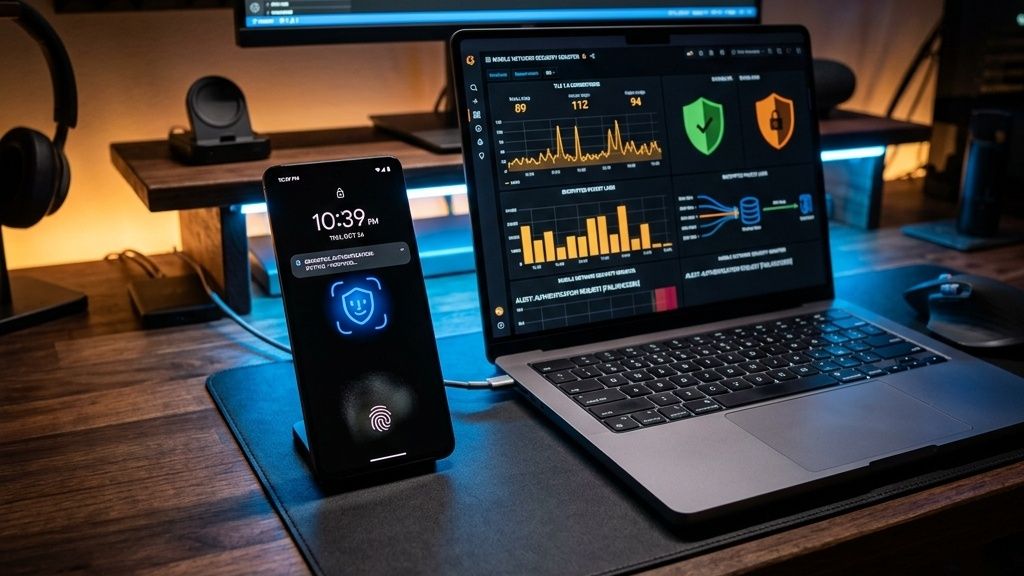
The High Stakes of Mobile App Security
In 2026, mobile applications are the primary touchpoint for consumers and enterprise users alike. Whether it’s a mobile banking app processing millions in transactions, a HealthTech app storing sensitive patient data, or an internal corporate tool accessing proprietary databases, the stakes for Mobile App Security have never been higher.
A single data breach doesn’t just result in regulatory fines (like GDPR or HIPAA penalties); it causes irreversible brand damage. For CTOs and product owners, relying on default OS security is no longer sufficient. When partnering with a software development company or hiring app developers, you must ensure that security is architected into the application from day one.
Critical Mobile Security Considerations
To protect your users and your business, every enterprise mobile application must address these critical security layers:
1. Secure Local Data Storage
A common mistake made by inexperienced app developers is storing sensitive data (like authentication tokens or personal info) in local unencrypted storage, such as NSUserDefaults (iOS) or SharedPreferences (Android).
- The Solution: Always use OS-provided secure storage mechanisms. For iOS, use the Keychain. For Android, use the EncryptedSharedPreferences or the Android Keystore system. For highly sensitive data in hybrid apps (like React Native), ensure you use libraries that bridge directly to these native secure enclaves.
2. API Security and Network Communication
Mobile apps are essentially front-end interfaces that constantly communicate with backend servers. If this communication channel is intercepted (e.g., via a Man-in-the-Middle attack on public Wi-Fi), user data is compromised.
- The Solution: Enforce strict Transport Layer Security (TLS 1.3) for all network traffic. Do not rely solely on standard SSL certificates. Implement SSL Pinning, which hardcodes the server’s certificate into the app, ensuring the app refuses to connect if an attacker tries to intercept the traffic with a spoofed certificate.
3. Code Obfuscation and Reverse Engineering Prevention
Once your app is published on the App Store or Google Play, the binary is publicly available. Attackers can decompile the app to extract API keys, database credentials, or proprietary algorithms.
- The Solution: Never hardcode sensitive API keys directly into the frontend source code. Fetch them dynamically from a secure backend upon authentication. Additionally, use code obfuscation tools (like ProGuard or DexGuard for Android) to make reverse engineering exceptionally difficult.
4. Robust Authentication and Session Management
Relying on simple username/password authentication is archaic and insecure.
- The Solution: Implement Multi-Factor Authentication (MFA) natively or utilize robust Identity Providers (like Auth0, Okta, or Firebase Auth). Ensure that session tokens expire rapidly and utilize refresh tokens securely. For ultimate security, implement biometric authentication (FaceID, TouchID) tied to the device’s secure hardware.
Partnering with Manifera for Secure Mobile Development
Building a secure mobile application requires specialized knowledge that goes far beyond standard UI/UX coding.
At Manifera, guided by CEO Herre Roelevink, we treat security as a foundational pillar, not an afterthought. Operating from our Amsterdam HQ, we ensure that all mobile applications we build adhere to the strictest European data privacy and security regulations.
Our development hubs in Vietnam and Singapore supply elite app developers who are rigorously trained in secure mobile development practices. From SSL Pinning to DevSecOps automated vulnerability scanning, our dedicated teams ensure that your mobile application is impenetrable, fast, and scalable.
FAQs
Is React Native less secure than fully native apps?
Not if built correctly. React Native can be just as secure as native apps when developers properly utilize bridges to native secure storage (Keychain/Keystore) and implement standard security practices like obfuscation and secure network layers.
How do you securely protect sensitive user data locally within React Native?
Standard local storage solutions like AsyncStorage do not encrypt data and are highly vulnerable. To protect sensitive credentials, elite development teams implement secure data-passing bridges that communicate directly with iOS Keychain and Android Keystore, ensuring hardware-level encryption.
What steps are necessary to protect enterprise mobile apps against reverse engineering?
Because cross-platform applications compile into bundled JavaScript code, they can be vulnerable to extraction if unprotected. Security teams mitigate this risk by applying rigorous code obfuscation tools (like ProGuard or JScrambler) and environmental integrity checks to prevent bad actors from reverse-engineering the codebase.
How do secure network layers prevent data interception in B2B mobile applications?
Mobile applications must secure all API communications against Man-in-the-Middle (MitM) attacks. This is achieved by enforcing strict HTTPS/TLS network layers combined with SSL Pinning protocols, ensuring the mobile application strictly communicates with your verified enterprise servers.
What is Manifera’s approach to offshore B2B software quality (Focus: Mobile App Security)?
We treat offshore teams as core extensions of your business. Quality is enforced through continuous integration, strict code reviews, and adherence to European engineering best practices. This is especially critical to ensure your Mobile App Security initiatives are executed with absolute precision.
Suggested Posts








How useful was this post?
Share it with your friends


Get our latest articles here!
Thank you for subscribing to our blog!
Do you have any questions?
Help us improve the content of this Insightful blog by asking us questions. Manifera's team of experts will help you answer these questions as soon as possible.
