
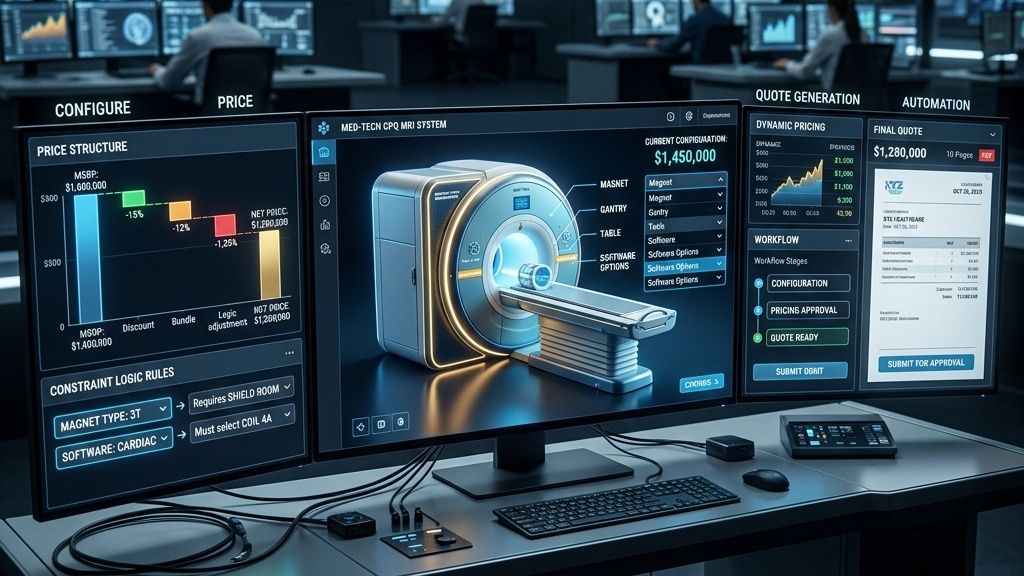
A global manufacturer of industrial MRI machines wants to launch a modern B2B ecommerce platform. They want hospitals to be able to log in and order MRI machines online.
The manufacturer hires a standard web development agency. The agency builds a beautiful website. They create a product page for the “Titan 5000 MRI Machine.”
The agency asks the manufacturer: “Okay, what price should we type into the database for the Titan 5000?”
The manufacturer’s Chief Revenue Officer laughs. “There is no price. It depends. Are they buying the standard magnet or the supercooled magnet? Are they in Germany or the US? Do they want the 5-year maintenance contract or the 10-year? Does the hospital have a pre-existing 15% global discount tier? If they add the advanced software package, the magnet gets a 5% bundle discount, but the maintenance contract price increases by 2%.”
The web development agency is horrified. A generic shopping cart (like Shopify or Magento) is mathematically incapable of processing this level of intersecting logic. If you try to force it, the database will literally deadlock.
To sell highly complex, configurable industrial products online, elite software engineering centers do not build shopping carts. They architect a massive, terrifying mathematical engine called CPQ (Configure, Price, Quote).
Here is the CTO-level deep dive into CPQ architecture in custom B2B ecommerce.
1. The “Configure” Engine (Constraint-Based Logic)
You cannot allow a hospital to configure an MRI machine that is physically impossible to build.
If the hospital selects the “Compact Chassis” option, they mathematically cannot select the “Mega-Cooling Fan” option, because the massive fan will not physically fit inside the small chassis.
If you use a generic eCommerce platform with standard drop-down menus, the hospital will select the conflicting options. The order will go to the factory. The factory will attempt to build it, fail, and the entire $500,000 order will be catastrophically delayed.
The Elite Architecture: The Constraint Solver Elite B2B ecommerce platforms utilize a Constraint Satisfaction Problem (CSP) Engine.
The engineering team writes thousands of highly specific mathematical rules.
- Rule 149: IF Chassis == Compact AND Fan == Mega_Cooling THEN state = INVALID.
When the user is clicking through the 3D configurator on the website, the Javascript frontend is constantly pinging the Constraint Solver API. The exact millisecond the user clicks “Compact Chassis,” the API instantly, mathematically disables the “Mega-Cooling Fan” button on the screen and turns it gray.
The software physically prevents the user from ordering an impossible machine.
2. The “Price” Engine (The Multi-Dimensional Matrix)
Once the machine is correctly configured, the system must calculate the price.
In B2B, the price is not a static number stored in a database column. The price is a living, breathing mathematical function that must be calculated in real-time.
The Elite Architecture: The Pricing Waterfall Elite CPQ platforms use a “Pricing Waterfall” architecture. The software does not calculate a single price; it calculates a cascading sequence of mathematical deductions.
- Base Price: The API calculates the raw sum of the physical components chosen in the Configurator. ($500,000)
- Bundle Logic: The API scans the cart. It notices the hospital bought the Software Package. It triggers Rule 99 and applies a 5% discount to the hardware. ($475,000)
- Contract Tier: The API queries the SAP ERP system. It identifies the hospital’s
tenant_idand realizes they are a “Tier 1 Global Partner” entitled to a 15% discount. ($403,750) - Geographic Tax/Tariff: The API checks the shipping destination (Germany) and dynamically adds the required EU import tariffs. ($425,000)
This entire 4-step mathematical waterfall must execute in less than 0.2 seconds so the hospital doesn’t experience lag when they click the “Update Cart” button. This requires terrifyingly fast PostgreSQL indexing and Redis in-memory caching.
3. The “Quote” Engine (The PDF Contract Generation)
In consumer ecommerce, you click “Buy” and your credit card is charged. In enterprise B2B ecommerce, a $425,000 transaction requires legal approval.
The user does not click “Buy.” The user clicks “Generate Quote.”
The Elite Architecture: Automated Document Assembly The CPQ engine takes the mathematically perfect configuration and the Pricing Waterfall data, and it feeds it into an automated Document Generation Microservice.
This microservice does not just print a receipt. It dynamically generates a 45-page, legally binding PDF contract.
- It automatically injects the exact German legal liability clauses based on the shipping destination.
- It automatically calculates the exact delivery timeline based on the factory’s real-time API inventory data.
- It automatically routes the PDF to the hospital’s CFO via an e-signature API (like DocuSign).
The CTO’s Mandate
If you manufacture complex machinery, chemicals, or software bundles, do not hire a web design agency to build a website. You must procure a hardcore software engineering firm to architect a B2B ecommerce CPQ engine. It is not a marketing tool; it is a hostile, uncompromising mathematical enforcer of your factory’s physics and your CFO’s pricing matrices.
FAQs
Why is traditional manual pricing failing in modern B2B E-commerce?
Modern B2B commerce involves hyper-complex product configurations, localized tax regulations, and dynamic volume-based tier pricing that are literally impossible to compute manually or via static spreadsheets. Relying on legacy systems creates massive human error vectors, leads to severe margin leakage, and forces client approval loops to drag on for days, killing overall deal momentum.
How does a Composable CPQ Architecture differ from traditional monolithic software?
Monolithic systems lock enterprises into highly rigid, expensive ecosystems that are incredibly slow to adapt to new business goals. A Composable, API-first CPQ Architecture decouples the core logic into flexible, scalable microservices. This allows companies to isolate and update individual rules, easily swap out modules, and seamlessly integrate pricing engines with existing CRM and ERP data layers without breaking the ecosystem.
What specific role do automated constraint and rules engines play under the hood?
The rules engine acts as the structural brain of the CPQ framework. It processes real-time engineering and financial boundaries to prevent incompatible system configurations from being selected by sales reps or buyers. By enforcing these predefined technical constraints instantly at the point of configuration, it eradicates downstream fulfillment errors, eliminates production rework, and guarantees margin protection across all sales pipelines.
Suggested Posts




How useful was this post?
Share it with your friends


Get our latest articles here!
Thank you for subscribing to our blog!
Do you have any questions?
Help us improve the content of this Insightful blog by asking us questions. Manifera's team of experts will help you answer these questions as soon as possible.
