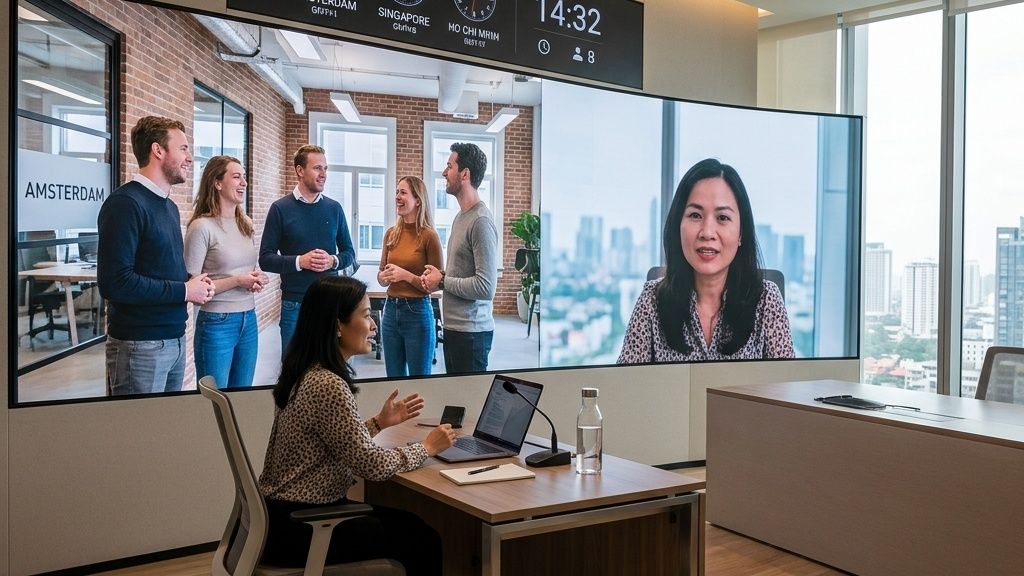
Your Amsterdam CTO wakes up at 8 AM. Your Vietnamese development team is finishing lunch. Your Singapore PM is in an afternoon meeting. Your American investor wants a weekly update “first thing in the morning” — which morning?
Distributed engineering is the norm in 2026, but most teams still run standups as if everyone sits in the same office. The result: meetings at inconvenient hours that nobody pays attention to, async updates that nobody reads, and a persistent feeling that the left hand does not know what the right hand is doing.
Here is a battle-tested framework for making standups work across any timezone configuration.
The Core Principle: Optimize for Overlap, Not Symmetry
Stop trying to find a time that “works for everyone.” It does not exist when your team spans 6+ hours. Instead, identify your critical communication pairs and optimize for their overlap.
In a typical European-Asian setup:
- Amsterdam (CET, GMT+1) ↔ Ho Chi Minh City (GMT+7): 6-hour difference
- Overlap window: 9:00-13:00 CET = 15:00-19:00 Vietnam time
This gives you a solid 4-hour window every day. Use it strategically.
The Two-Tier Standup System
Tier 1: Async Daily Update (Everyone)
Every team member posts a structured update in a dedicated Slack channel before their workday begins:
✅ Yesterday: [completed tasks with ticket links]
🔄 Today: [planned tasks]
🚧 Blockers: [anything preventing progress]
Rules:
- Posted within the first 30 minutes of their workday
- Maximum 5 lines. Not a diary entry.
- Tag specific people if a blocker requires their input
- Use threads for discussion, not the main channel
Tier 2: Synchronous Standup (Critical Path Only)
A 15-minute video call during the overlap window for:
- Engineers working on the same feature
- Any unresolved blockers from async updates
- Architecture decisions that need real-time discussion
Not everyone attends Tier 2. Only the engineers who are actively collaborating on the same sprint items.
Sprint Ceremonies Across Time Zones
Tools That Actually Work
- Slack (async updates, threaded discussions) — the backbone of async communication
- Loom (async video updates) — when something is too complex for text but does not need real-time discussion
- Linear/Jira (task tracking) — the source of truth for what is in progress
- Notion/Confluence (documentation) — decisions, architecture records, and meeting notes
- Around/Google Meet (sync calls) — for the overlap-window meetings
The Manifera Protocol
At Manifera, the Amsterdam-Ho Chi Minh City timezone gap is managed with a refined version of this system. Dutch project managers facilitate the overlap-window syncs, ensuring that European clients receive morning status updates in their inbox and can join afternoon calls with the Vietnamese engineering team when needed.
This structured approach has proven itself across 160+ projects — delivering the collaboration benefits of co-location without the geographical constraints.
FAQs
What if an urgent issue happens outside the overlap window?
Define an escalation protocol. Critical production issues go to an on-call rotation via PagerDuty or Opsgenie. Non-critical but urgent items get a Slack DM with a 2-hour SLA response commitment. Everything else waits for the next overlap window.
How do I prevent async standup fatigue?
Keep updates to 5 lines maximum. Rotate who leads the sync standup weekly. Cancel the sync standup on days where the async updates show zero blockers — not every day needs a video call.
Should the team lead be in both time zones?
Ideally, yes — or at least be willing to flex their schedule to cover the overlap window. Many engineering managers adopt a “shifted day” (10 AM to 7 PM) to maximize coverage across both time zones.
How does the hybrid offshore model maintain software quality (Scenario: How to Run Effective Standups Across 6 Time Zones)?
By combining local European account management with elite offshore talent, we ensure nothing is lost in translation. Our Vietnam and Singapore teams follow strict coding standards validated by our lead architects. This ensures your offshore software development initiatives are executed with absolute precision.
How does Manifera guarantee high-quality offshore engineering (Scenario: How to Run Effective Standups Across 6 Time Zones)?
Our Amsterdam HQ provides strategic oversight while our Vietnam and Singapore hubs handle execution. This dual-shore model ensures European quality standards with offshore scalability. This ensures your offshore software development initiatives are executed with absolute precision.
Suggested Posts







How useful was this post?
Share it with your friends


Get our latest articles here!
Thank you for subscribing to our blog!
Do you have any questions?
Help us improve the content of this Insightful blog by asking us questions. Manifera's team of experts will help you answer these questions as soon as possible.