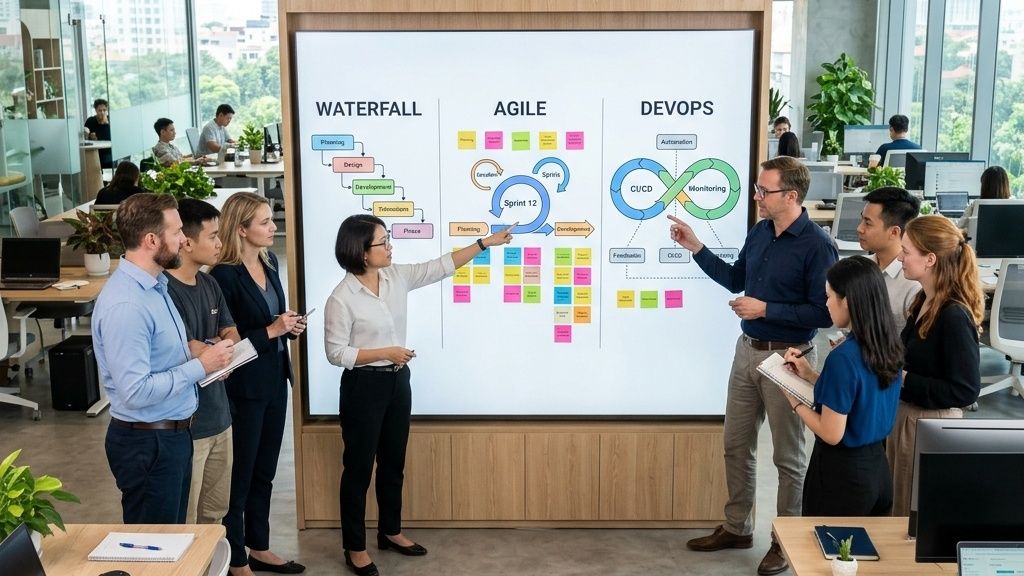
“We’re Agile” has become the corporate equivalent of “We recycle” — everyone claims it, few do it properly, and the ones who do it best never feel the need to announce it. The software development model you choose is not a philosophical statement. It is an engineering constraint that determines your delivery cadence, team structure, and cost predictability. Here are five models that actually work in production environments, with clear guidance on when each one wins.
Model 1: Waterfall (Yes, It Still Has a Place)
How it works: Linear, sequential phases. Requirements → Design → Development → Testing → Deployment. Each phase completes before the next begins.
When it wins:
- Regulatory or contractual environments requiring complete specifications upfront (medical devices, aerospace, government contracts)
- Fixed-scope projects with well-understood requirements that will not change
- Projects requiring formal sign-offs between phases (compliance audit trails)
When it fails:
- Any project where requirements will evolve (which is most software)
- Consumer-facing products where user feedback should shape development
- Long timelines (>6 months) where market conditions change during development
Real-world benchmark: A 2024 Standish Group CHAOS Report found that pure Waterfall projects over €1M had a 29% success rate. Not ideal, but not zero — it still works for the right context.
Model 2: Agile Scrum
How it works: Iterative 2-week sprints. Product Backlog → Sprint Planning → Development → Sprint Review → Retrospective. Repeat.
When it wins:
- Product development with evolving requirements
- Teams of 5-9 developers (Scrum’s optimal team size)
- Projects where stakeholder feedback should influence direction every 2 weeks
When it fails:
- Teams larger than 12 without SAFe or LeSS frameworks (coordination overhead explodes)
- Maintenance-heavy work with no clear “sprint goal”
- Organisations unwilling to empower Product Owners with real authority
As Gene Kim observes in The Unicorn Project: “Scrum tells you how to organise work. It does not tell you how to do the work well. The teams that succeed at Scrum also invest in technical practices — CI/CD, automated testing, refactoring.”
Manifera’s way of working is built on Scrum with technical practices baked in — not as an afterthought.
Model 3: Kanban
How it works: Continuous flow with Work-in-Progress (WIP) limits. No sprints, no iterations — items flow through columns (To Do → In Progress → Review → Done) at their own pace.
When it wins:
- Support and maintenance teams with unpredictable work intake
- Operations teams handling both planned and unplanned work
- Teams already delivering continuously and finding sprint boundaries artificial
When it fails:
- Teams that need the discipline of sprint commitments to maintain focus
- Projects requiring clear delivery milestones for stakeholder reporting
- Teams without the maturity to self-manage without sprint structure
Model 4: DevOps / Continuous Delivery
How it works: Not a methodology but an operational philosophy: merge development and operations into a single feedback loop. Code → Build → Test → Release → Monitor → Feedback → Code. Fully automated pipelines enable deployment on every commit.
When it wins:
- SaaS products requiring daily or on-demand deployments
- Companies where deployment frequency directly impacts revenue (e-commerce, fintech)
- Organisations with mature testing cultures and infrastructure automation
When it fails:
- Companies without automated testing (deploying untested code continuously is chaos)
- Regulated environments requiring manual approval gates (though this is changing)
- Teams without platform engineering support (DIY DevOps burns developer time)
Werner Vogels’ famous principle applies here: “You build it, you run it.” But as we discussed, this requires platform engineering support in 2026 to avoid turning every developer into a part-time sysadmin.
Model 5: Shape Up (Basecamp Method)
How it works: 6-week build cycles followed by 2-week cooldown. Senior leaders “shape” work into clear pitches with fixed time, variable scope. Teams have full autonomy during the cycle.
When it wins:
- Product companies that want longer focus periods than Scrum’s 2-week sprints
- Teams frustrated by the overhead of daily standups, sprint planning, and retrospectives
- Organisations where scope flexibility is acceptable (delivering the best version possible within the time box)
When it fails:
- Client-facing projects with fixed scope (variable scope terrifies clients)
- Large teams requiring coordination (Shape Up assumes small, autonomous teams)
- Organisations that need frequent stakeholder check-ins (6-week black boxes create anxiety)
The Decision Matrix
Most high-performing teams in 2026 do not use a single model. They combine Scrum’s planning discipline with DevOps’ deployment automation and Kanban’s flow management. The model is a tool, not a religion.
Schedule a free consultation with our Amsterdam team to discuss which model fits your project — manifera.com/contact-us.
FAQs
Can we use different development models for different projects simultaneously? (Scenario: CTO managing 4 parallel projects)
Absolutely. Many mature organisations use Scrum for new product development, Kanban for support, and DevOps practices across all projects. The key is ensuring each team understands their model’s ceremonies and metrics without forcing uniformity. What matters is consistency within each team, not consistency across the organisation.
How does the development model affect cost estimation for offshore projects? (Scenario: CFO budgeting for a Vietnam-based development team)
Waterfall provides the most predictable upfront cost estimates because scope is fixed. Agile provides the most predictable cost per sprint but variable total project cost. For offshore engagements, time-and-materials contracts paired with Agile Scrum tend to deliver the best value — you pay for actual work delivered, with sprint-level budget visibility.
Is Scrum too ceremonial for small teams of 3-4 developers? (Scenario: Startup founder with a lean engineering team)
Standard Scrum can be heavy for teams under 5. Strip it down: keep sprint planning (30 minutes), daily syncs (10 minutes, async is fine), and retrospectives (30 minutes bi-weekly). Drop the formal Sprint Review — a Slack message with a demo video achieves the same purpose with less overhead.
What development model works best when the client and development team are in different time zones? (Scenario: Dutch product manager working with Southeast Asian developers)
Scrum with asynchronous enhancements works best. Replace daily standups with async written updates, use recorded demo videos for sprint reviews, and overlap 3-4 hours daily for real-time pairing sessions. Manifera’s teams in Vietnam overlap with European time zones from 14:00-17:00 CET, which is sufficient for all critical synchronous communication.
How do we transition from Waterfall to Agile without disrupting ongoing projects? (Scenario: IT Manager at a traditional enterprise starting Agile transformation)
Do not attempt an organisation-wide Agile transformation simultaneously. Start with one team on one new project. Let them practice Scrum for 3-4 sprints, document what works, and share results internally. Success stories from a real team are far more persuasive than management mandates. Scale only after the pilot team demonstrates measurable improvements in delivery speed and quality.
Suggested Posts








How useful was this post?
Share it with your friends


Get our latest articles here!
Thank you for subscribing to our blog!
Do you have any questions?
Help us improve the content of this Insightful blog by asking us questions. Manifera's team of experts will help you answer these questions as soon as possible.