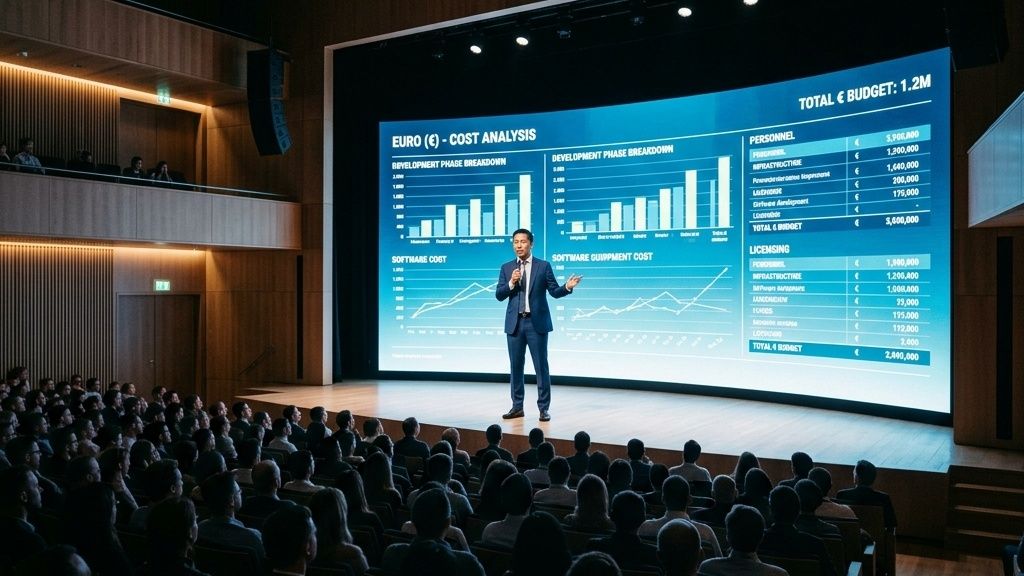
“How much does it cost to build an app?” is the software industry’s version of “How long is a piece of string?” — except the string costs €50,000-€500,000 and nobody tells you that upfront. This article does. No vague ranges, no “it depends” cop-outs. Real numbers based on real market data in 2026.
Developer Hourly Rates by Region (2026 Market Data)
The single largest cost variable in custom software development is where your team is located. Here is the 2026 reality:
The crucial nuance: Hourly rate does not equal total cost. A €25/hr developer who takes 800 hours costs more than a €65/hr developer who delivers in 300 hours. Quality and velocity matter more than rate.
Manifera, with its Amsterdam headquarters and Ho Chi Minh City development hub, operates in the Southeast Asia tier — combining the cost advantages of Vietnam with Dutch project management standards. This dual-shore model typically delivers custom software at 40-60% lower cost than pure Western European engagements without sacrificing quality.
Cost by Project Complexity
Tier 1: Simple Application (€15,000 – €50,000)
What you get:
- 3-5 screens/pages
- Basic CRUD operations (Create, Read, Update, Delete)
- User authentication
- Simple database
- Responsive design
- Basic admin panel
Examples: Internal tool for tracking inventory, customer feedback portal, employee directory, simple booking system.
Timeline: 6-12 weeks | Team: 1 developer + 1 QA (part-time)
Tier 2: Medium-Complexity Application (€50,000 – €150,000)
What you get:
- 10-20 screens/pages
- Multiple user roles with permissions
- Third-party API integrations (payment, email, analytics)
- Custom business logic
- Reporting/dashboard
- Mobile-responsive or native mobile app
- Automated testing suite
Examples: E-commerce platform with custom pricing, multi-tenant SaaS product, project management tool, healthcare patient portal.
Timeline: 12-24 weeks | Team: 2-3 developers + 1 QA + 1 PM
Tier 3: Complex / Enterprise Application (€150,000 – €500,000+)
What you get:
- 30+ screens/pages
- Complex workflows and state machines
- Real-time features (WebSockets, live updates)
- AI/ML integration
- Multi-language / multi-currency
- Advanced security (SOC2, GDPR compliance)
- Microservices architecture
- High-availability infrastructure
- Comprehensive API layer
Examples: Financial trading platform, healthcare records system, logistics management suite, enterprise resource planning (ERP) system.
Timeline: 6-18 months | Team: 4-8 developers + 2 QA + 1 PM + 1 DevOps + 1 architect
The Hidden Costs Nobody Mentions
1. Discovery and Architecture Phase: €5,000 – €20,000
This is not optional. Skipping discovery is the single most expensive mistake in software development. This phase produces wireframes, architecture diagrams, technical specifications, and project plans.
2. UI/UX Design: €8,000 – €30,000
Professional design is not “making it pretty.” It is reducing user confusion, improving conversion rates, and preventing expensive redesigns later. Budget 15-20% of total development cost for design.
3. Third-Party Services (Annual)
4. Post-Launch Maintenance: 15-25% of Build Cost Annually
Bug fixes, security updates, dependency updates, server monitoring, and minor feature enhancements. Budget €200-€5,000/month depending on complexity.
5. Legal and Compliance: €2,000 – €15,000
Privacy policies, terms of service, GDPR compliance documentation, data processing agreements. Essential for EU-facing products.
How to Structure Your Budget for Maximum ROI
Werner Vogels, CTO of Amazon, advocates “two-pizza teams” — small teams that can be fed with two pizzas. The principle applies to budgets: smaller, focused investments deliver more than massive upfront commitments.
The Phased Budget Approach:
This approach means you never commit the full budget before validating that the product works. If the MVP fails market validation, you have spent only 45% of the total budget — not 100%.
The Cost-Quality Relationship (Honest Truth)
There is a floor below which quality collapses. Here it is:
Cutting corners on any of these creates technical debt that costs 3-5x more to fix later.
Talk to one of our senior architects about your specific challenge — schedule a free consultation at manifera.com/contact-us.
FAQs
What is the average cost to build a mobile app in 2026? (Scenario: Startup founder budgeting for a consumer iOS/Android app)
A simple mobile app (one platform, 5-8 screens, basic features) costs €20,000-€50,000 with an offshore team. A medium-complexity app (both platforms via React Native or Flutter, 15+ screens, integrations) costs €50,000-€120,000. A complex app (real-time features, AI, payment processing, enterprise security) costs €120,000-€300,000. These ranges assume offshore development rates; multiply by 2-3x for Western European agencies.
How do I compare proposals from different development companies? (Scenario: CEO who received three wildly different quotes for the same project)
Compare on four dimensions, not just price: (1) Scope — is the same set of features included? (2) Team composition — how many seniors vs juniors? (3) What is included vs extra — are QA, project management, discovery, and DevOps setup included or billed separately? (4) Post-launch support — what happens after delivery? The cheapest quote often excludes testing, documentation, and deployment — which you will pay for anyway.
Is fixed-price or time-and-materials better for custom development? (Scenario: CFO negotiating contract terms with an offshore partner)
Fixed-price works for well-defined, small-scope projects (under €50,000) where requirements are unlikely to change. Time-and-materials is better for complex or evolving projects because it allows scope flexibility without change-order overhead. A hybrid approach — fixed-price for discovery, time-and-materials for development with sprint-level budget caps — gives you cost predictability with scope flexibility.
How much should I budget for year-two costs after launch? (Scenario: Financial controller building a 3-year IT budget forecast)
Budget 15-25% of the original build cost annually for maintenance. For a €100,000 build, that is €15,000-€25,000/year covering bug fixes, security patches, dependency updates, and minor enhancements. Add €5,000-€15,000/year for infrastructure (hosting, monitoring, third-party services). Major feature additions are budgeted separately as new development projects.
Can I start with a small budget and scale up as the product proves itself? (Scenario: Bootstrap founder with €30,000 initial capital)
Yes — this is the recommended approach. Invest €5,000-€8,000 in discovery and architecture. Then spend €20,000-€25,000 on an MVP with the 3 most critical features. Launch to early users, validate demand, then raise funding or reinvest revenue for the next phase. Manifera’s flexible engagement model allows you to start with a small team and scale up as your product gains traction.
Suggested Posts








How useful was this post?
Share it with your friends


Get our latest articles here!
Thank you for subscribing to our blog!
Do you have any questions?
Help us improve the content of this Insightful blog by asking us questions. Manifera's team of experts will help you answer these questions as soon as possible.