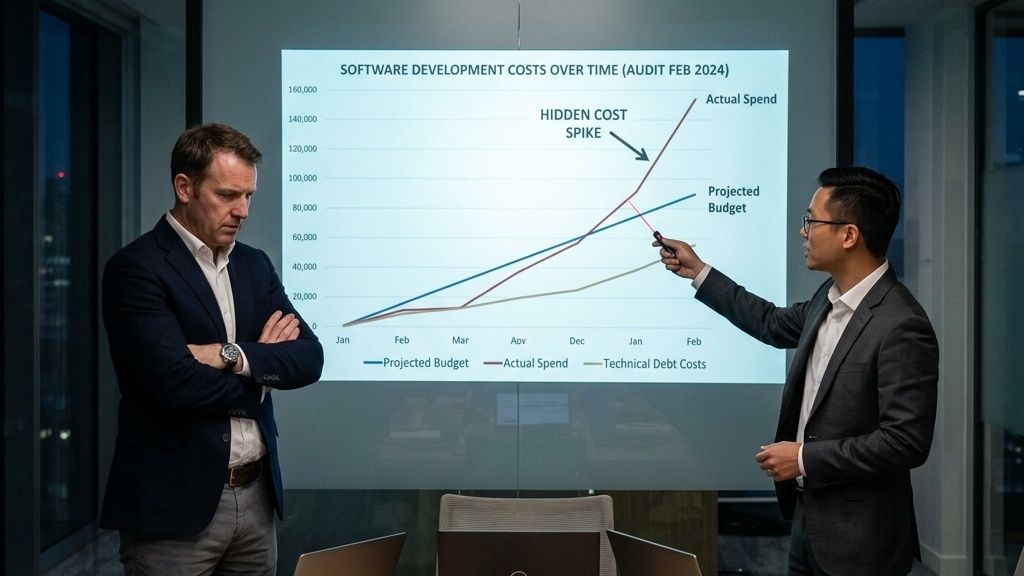
The CFO sees two proposals: Partner A at €35/hour and Partner B at €18/hour. For a 2,000-hour project, that is €70,000 versus €36,000. “We would be foolish not to choose Partner B,” she says. The CTO winces. He has seen this movie before.
Eight months later, the project is over budget, behind schedule, and the codebase requires a complete rewrite. The final cost? €140,000 — double the “expensive” option.
This article is the autopsy of that decision. Here are the hidden costs that the €18/hour proposal never mentioned.
Hidden Cost #1: The Junior Developer Bait-and-Switch
How it works: The proposal features impressive senior developer profiles. After signing, you discover those seniors are “temporarily assigned to another project.” Your actual team consists of engineers with 6-18 months of experience who have never built a production system.
The cost: Junior developers take 3-4× longer to implement features correctly. They produce code with more bugs, less documentation, and architectural decisions that create technical debt. A task that a senior developer completes in 8 hours takes a junior 24-32 hours — plus 8 hours of rework after code review.
How to prevent it: Interview every engineer who will work on your project. Include a technical assessment. And contractually guarantee that specific individuals are assigned to your team for the duration.
Hidden Cost #2: Zero Testing Culture
How it works: At €18/hour, there is no budget for QA engineers, no time for writing automated tests, and no expectation of test coverage. The code “works” in a demo environment but breaks in production.
The cost: Every bug found in production costs 10-30× more to fix than a bug caught during development. Without automated tests, every new feature introduces regressions in existing functionality. Your product becomes increasingly unstable over time.
Hidden Cost #3: Communication Overhead Tax
How it works: At bottom-market rates, the partner cannot afford dedicated project managers. The developers communicate directly with you — in broken English, without context on your business requirements, and without anyone translating between your product vision and their task list.
The cost: You become the project manager. Every unclear requirement generates a back-and-forth chain of 5-10 messages. Your CTO spends 15-20 hours per week managing the offshore team instead of doing architecture and strategy work. At a CTO hourly cost of €150+, that management overhead costs €120,000/year — more than the entire development team.
Hidden Cost #4: The Rewrite Tax
How it works: Cheap development produces code that works today but cannot scale tomorrow. No documentation, no architecture patterns, spaghetti code that only the original developer can understand (and they have already left for a higher-paying client).
The cost: When you need to add features, integrate with new systems, or scale for performance, the codebase must be partially or completely rewritten. Industry benchmarks suggest rewrite projects cost 60-80% of the original development cost.
Hidden Cost #5: Security Vulnerabilities as Standard
How it works: At rock-bottom rates, there is no budget for security audits, SAST/DAST scanning, or penetration testing. The code ships with SQL injection vulnerabilities, hardcoded API keys, unvalidated user inputs, and missing authentication on internal APIs.
The cost: A single data breach costs an average of €4.3 million (IBM Cost of a Data Breach Report). Even without a breach, failing a security audit can delay your product launch by months and destroy investor confidence.
The Total Cost Comparison
The “cheap” option costs 2.3× more over two years.
How to Spot Quality Partners
Quality-focused offshore partners share these traits:
- Transparent team composition (meet the actual engineers)
- Included QA and code review processes
- Dedicated project management
- Documented development standards
- Willingness to start with a paid pilot project
Manifera operates on the principle that sustainable pricing produces sustainable partnerships. European governance from Amsterdam ensures that engineering quality, communication standards, and security practices meet the expectations of enterprise clients.
Request a transparent proposal with detailed cost breakdown: manifera.com/contact-us.
FAQs
What is a fair hourly rate for quality offshore development?
For Southeast Asian markets with senior engineers, expect €30-€50/hour. This includes QA, project management, and proper engineering practices. Rates below €20/hour almost always indicate junior talent, missing QA, or subcontracting.
How can I verify if the quoted developers will actually work on my project?
Include a contractual clause requiring notification and approval before any team member changes. Conduct technical interviews with each assigned developer. Request weekly timesheets with task-level detail.
Is it better to pay fixed-price or time-and-material?
For well-defined scopes (MVP, specific feature), fixed-price protects you from scope creep. For ongoing development with evolving requirements, time-and-material with a dedicated team is more efficient. The key is matching the pricing model to the predictability of your requirements.
How does the hybrid offshore model maintain software quality (Focus: software development cost)?
By combining local European account management with elite offshore talent, we ensure nothing is lost in translation. Our Vietnam and Singapore teams follow strict coding standards validated by our lead architects. This ensures your software development cost initiatives are executed with absolute precision.
How does Manifera guarantee high-quality offshore engineering (Focus: software development cost)?
Our Amsterdam HQ provides strategic oversight while our Vietnam and Singapore hubs handle execution. This dual-shore model ensures European quality standards with offshore scalability. This ensures your software development cost initiatives are executed with absolute precision.
Suggested Posts








How useful was this post?
Share it with your friends


Get our latest articles here!
Thank you for subscribing to our blog!
Do you have any questions?
Help us improve the content of this Insightful blog by asking us questions. Manifera's team of experts will help you answer these questions as soon as possible.