
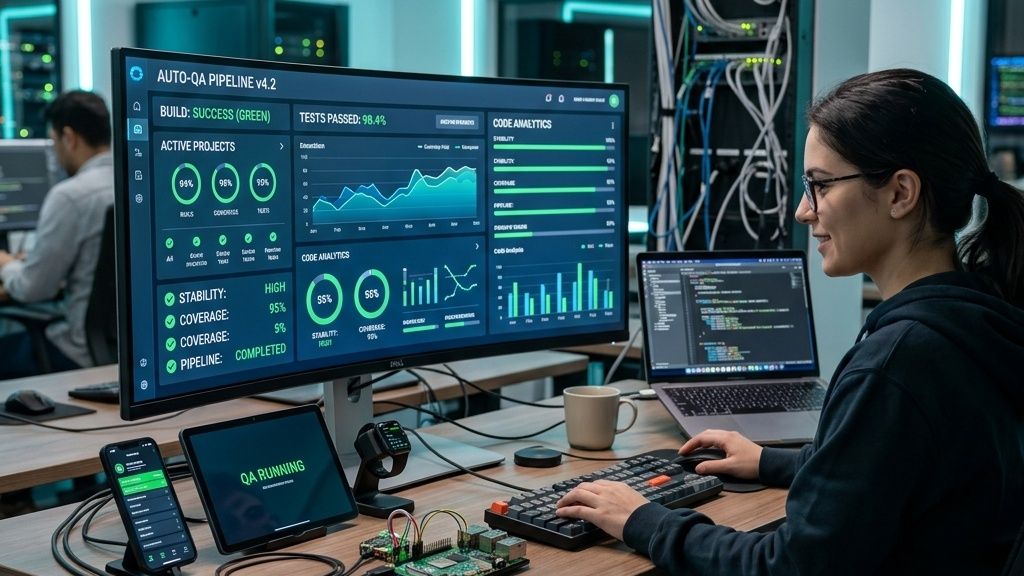
The Evolution of Quality Assurance
In the past, Quality Assurance (QA testing) was often treated as an afterthought—a bottleneck phase tacked onto the end of the software development lifecycle just before release. A team of manual testers would frantically click through the application, inevitably delaying the launch.
In 2026, that archaic model is obsolete. Modern software requires continuous deployment, sometimes multiple times a day. To support this velocity without deploying catastrophic bugs to production, QA has evolved from manual checking into a highly technical, automated engineering discipline.
For CTOs and engineering leaders, staying ahead of QA trends is critical to maintaining a competitive edge. Let’s explore the future trends in Quality Assurance and how leading software development companies are implementing them.
Trend 1: AI and Machine Learning in Test Automation
Artificial Intelligence is fundamentally changing how we approach test automation. Historically, automated UI tests (using tools like Selenium) were incredibly brittle; a slight change to a CSS class or button ID would break the entire test script, requiring constant maintenance.
The Future: AI-augmented software tools now utilize machine learning for “self-healing” tests. If a UI element moves or changes slightly, the AI dynamically identifies the new element and updates the test script on the fly. Furthermore, predictive AI models can analyze the codebase to determine exactly which tests need to be run based on the specific lines of code that were changed, drastically reducing CI/CD pipeline execution times.
Trend 2: The “Shift-Left” Methodology
The cost of fixing a bug increases exponentially the later it is found in the development cycle. Discovering a security flaw in production is infinitely more expensive than catching it during the design phase.
The Future: QA is moving to the very beginning of the pipeline—a concept known as “Shift-Left.” QA engineers are now involved in requirement gatherings, architecture reviews, and sprint planning. Developers and QA collaborate to write automated tests (TDD – Test Driven Development) before the actual feature code is written. Quality is baked into the product from day one, not inspected at the end.
Trend 3: QA in the Age of IoT and Edge Computing
As the Internet of Things (IoT) expands, software no longer just lives on web browsers and smartphones. It lives on smart watches, medical devices, logistics trackers, and edge servers.
The Future: QA testing must expand beyond standard screen resolutions. QA engineers must simulate complex network conditions, hardware battery constraints, and intermittent connectivity. This requires specialized software tools capable of mocking hardware responses and executing tests across massive device farms in the cloud.
Trend 4: DevSecOps (Security as Code)
Security testing (Penetration testing, vulnerability scanning) can no longer be outsourced to an annual audit.
The Future: Quality Assurance now explicitly includes Security Assurance. Automated security scanning (SAST and DAST) is integrated directly into the CI/CD pipeline. Every time a developer commits code, it is automatically scanned for vulnerabilities, exposed API keys, and outdated dependencies (DevSecOps).
Elevating Your QA Strategy with Manifera
Implementing these advanced QA strategies—AI automation, Shift-Left, and DevSecOps—requires highly skilled Automation Engineers. Building this capability in-house is time-consuming and expensive.
This is where a specialized software development company like Manifera excels. Guided by CEO Herre Roelevink from our Amsterdam HQ, we provide European clients with strategic oversight and rigorous quality governance.
Simultaneously, our tech hubs in Vietnam and Singapore supply dedicated QA Automation Engineers who are experts in the latest testing frameworks (Cypress, Playwright, Appium) and AI testing tools. By integrating Manifera’s dedicated QA teams into your Agile sprints, you ensure that your software is not only delivered faster but is inherently secure, performant, and future-proof.
FAQs
What is the difference between manual QA and automated QA?
Manual QA involves a human interacting with the software to find bugs, which is crucial for exploratory testing and assessing User Experience (UX). Automated QA uses scripts and software tools to execute repetitive tests instantly, which is essential for regression testing in CI/CD pipelines.
What is “Shift-Left” testing (Scenario: Future Trends in Quality Assurance for Software Development)?
Shift-Left testing is the practice of moving QA and testing activities earlier in the software development lifecycle, involving QA engineers during the requirement and design phases to prevent bugs rather than just detecting them later.
How can AI improve QA testing?
AI improves QA by enabling “self-healing” test scripts that adapt to UI changes, generating test cases based on user behavior data, and predicting where bugs are most likely to occur based on historical code commits.
Can an offshore team handle complex automated QA?
Absolutely. At Manifera, our offshore hubs in Vietnam provide elite SDETs (Software Development Engineers in Test) who specialize in building robust, automated CI/CD testing pipelines that align perfectly with European quality standards.
How does the hybrid offshore model maintain software quality (Scenario: Future Trends in Quality Assurance for Software Development)?
By combining local European account management with elite offshore talent, we ensure nothing is lost in translation. Our Vietnam and Singapore teams follow strict coding standards validated by our lead architects. This is especially critical to ensure your Quality Assurance initiatives are executed with absolute precision.
Suggested Posts








How useful was this post?
Share it with your friends


Get our latest articles here!
Thank you for subscribing to our blog!
Do you have any questions?
Help us improve the content of this Insightful blog by asking us questions. Manifera's team of experts will help you answer these questions as soon as possible.
