
The most expensive mistake in software development is not a buggy release. It is flawlessly executing a six-month development cycle to build a product that nobody wants to use, or building a feature set that solves the wrong business problem.
According to PMI’s Pulse of the Profession research on requirements management, nearly half (47%) of unsuccessful projects fail to meet their original goals because of inaccurate requirements management – and the same research found that only 36% of organizations rate requirements management as a critical competency they fully invest in, while 55% treat it as only somewhat important. Startups and enterprises alike often rush to write code because code feels like “real progress.”
In 2026, premium development agencies refuse to start coding on day one. They require a rigorous Product Discovery Phase. This initial 2-to-4 week period is where the ROI of your entire software investment is actually secured.
What is a Product Discovery Phase?
Product Discovery is the systematic process of reducing uncertainty before committing to expensive engineering resources. Marty Cagan, founder of the Silicon Valley Product Group (SVPG) and author of Inspired, formalized this as four big risks that every product idea carries until it has been validated:
- Value risk: Will users actually choose to use this, or customers choose to buy it?
- Usability risk: Can users figure out how to use it without confusion or hand-holding?
- Feasibility risk: Can engineers actually build it with the time, skills, and technology available?
- Business viability risk: Does it work for the rest of the business – sales channel, legal and compliance constraints, unit economics, and brand?
Cagan’s framing matters because it names a risk most Discovery processes quietly skip: usability. A concept can be desirable and technically feasible and still fail because users cannot figure out how to use it – which is exactly why the interactive prototype (deliverable #2 below) exists as a distinct step from the personas and journey maps that address value risk.
When outsourcing custom software development, you are not just buying coding capacity; you should be buying a structured process for retiring these four risks before a single sprint begins.
The 4 Deliverables of a Successful Discovery Phase
A professional Discovery Phase is not just a series of brainstorming meetings. It results in concrete, highly technical deliverables that form the blueprint for development.
1. User Journey Maps & Personas
You cannot build software for “everyone.” Discovery identifies 2-3 specific user personas and maps their exact journey through the proposed software.
Why it matters: It exposes massive edge cases early. [e.g., “Wait, what happens if the ‘Admin’ persona is on vacation and the ‘Clerk’ persona needs to approve an invoice?”]
2. High-Fidelity Interactive Prototypes
This is the most critical deliverable. Using Figma, the UX/UI team creates a clickable prototype of the application. It looks and feels like real software, but requires zero code.
Why it matters: You put this prototype in front of real users. When they get confused and click the wrong button, you fix the Figma file in 10 minutes. If you waited until the software was coded to discover this usability flaw, it would cost days of engineering time to refactor the frontend instead – and this is not a new observation. Barry Boehm’s research at TRW, first published in a 1976 IEEE paper and formalized in his 1981 book Software Engineering Economics, established what became known as the cost-of-change curve: a defect caught during requirements might cost a fixed unit to fix, the same defect costs roughly 10x more to fix once it reaches the design stage, and considerably more once it has been coded, tested, or shipped to production. Boehm later noted the multiplier is smaller for small, non-critical systems, but the direction of the curve – the earlier you catch a mistake, the cheaper it is – has held up across five decades of software engineering research and is precisely why a clickable Figma prototype is a cost-control tool, not a nicety.
3. Architecture & Tech Stack Blueprint
The Technical Architect reviews the prototype and non-functional requirements [e.g., “Must handle 10,000 concurrent users”] and defines the tech stack. Will it use Serverless or Kubernetes? Which database is optimal for the data structure?
Why it matters: Choosing the wrong database architecture requires a catastrophic, costly migration in year two.
4. The Phased Backlog (MVP Definition)
Discovery reins in scope creep. The agency will help you ruthlessly prioritize features into “Must Have” (MVP phase), “Should Have” (V2), and “Nice to Have” (V3).
Why it matters: It guarantees that your initial budget is spent only on features that validate the core business premise.
The Risk-Coverage Checklist: Auditing Discovery Against Cagan’s Four Risks
The four deliverables above are not arbitrary – each one exists to retire a specific risk. Use this table as an audit checklist before signing a development contract: for every risk, can your agency point to a concrete artifact that addresses it, and a named person accountable for it?
This is the most common gap in outsourced Discovery: agencies are structurally strong on feasibility (because that’s what engineers are good at evaluating) and structurally weak on business viability [because it requires someone with commercial authority in the room, not just technical staff]. When vetting a Discovery partner, ask specifically who on their team owns the viability risk – if the honest answer is “nobody, that’s on you,” budget for your own involvement accordingly.
Why You Should Outsource Discovery
Many founders believe they should do Discovery internally and only outsource the coding. This is often a mistake due to Founder Bias.
Founders are inherently optimistic about their ideas. An external Product Owner and UX Designer brings objective, ruthless pragmatism. They are paid to poke holes in your assumptions, ask the difficult technical questions, and force you to define success metrics objectively.
Furthermore, having the same agency conduct the Discovery and the Development ensures zero context loss. The developers who build the product are guided by the Architect and Product Owner who literally wrote the blueprint.
A Week-by-Week Breakdown of the 4-Week Discovery Sprint
Founders often ask what actually happens, day-to-day, during those 2-4 weeks before a single line of code is written. Here is the standard cadence for a 4-week Discovery sprint on a mid-sized SaaS MVP, so you know exactly what to expect and can hold your agency accountable to a real schedule rather than a vague “we’ll figure it out as we go.”
Why the sequencing matters: each week’s output becomes the next week’s input. Skipping straight from stakeholder interviews to prototyping (bypassing formal journey mapping) is the single most common shortcut agencies take to compress the timeline, and it is also the most common cause of a prototype that looks polished but is architecturally naive – for example, a beautiful multi-step checkout flow that nobody validated against the actual payment provider’s API constraints until week 6 of development, forcing a redesign.
A useful accountability check for founders: ask your agency to show you the Week 1 “Problem Statement” and Week 4 “Architecture Blueprint” side by side before signing the development contract. If the blueprint doesn’t visibly trace back to specific findings from the interviews and usability tests, the Discovery phase was theater, not research.
For enterprise-scale legacy modernization work rather than a greenfield MVP, this same 4-week cadence typically expands to 6-8 weeks, with Week 1-2 dedicated entirely to reverse-engineering undocumented legacy data structures and integration points before any new persona or journey work can begin credibly. Founders evaluating a proposed timeline should treat any Discovery quote that compresses this into a single week, regardless of project size, as a signal the agency intends to skip the research and start writing code on assumptions – precisely the failure mode Discovery exists to prevent.
The Discovery Process at Manifera
We do not write code based on assumptions. At Manifera, our Amsterdam-based Product Owners and Technical Architects run high-intensity Discovery workshops with your stakeholders. We create the interactive prototypes, validate the architecture, and define the agile backlog.
Once the blueprint is rock-solid, our offshore development teams in Vietnam execute the build with precision, speed, and zero ambiguity.
Build the right thing, before you build it right – manifera.com/contact-us.
FAQs
Does a Discovery Phase guarantee the software will be successful? [Scenario: CEO hesitant to pay for non-coding time]
No, but it drastically reduces the risk of catastrophic failure. Discovery guarantees that you will not waste €100,000 building features that are technically unfeasible or fundamentally unwanted by the market. Think of the Discovery fee (usually 10-15% of the total project budget) as an insurance policy against building the wrong product.
How long should Product Discovery take? [Scenario: Startup founder in a rush to launch]
For a standard SaaS MVP or mobile application, Discovery typically takes 2 to 4 weeks. For complex enterprise legacy modernizations, it can take 6 to 8 weeks to fully map the existing data structures and integration points. If an agency promises to do Discovery in 2 days, they are just writing down your feature list, not analyzing it.
What if we want to change features after the Discovery phase is over? [Scenario: Agile-focused Product Manager]
You absolutely will change features. Discovery does not replace Agile; it enables it. Discovery defines the “North Star” architecture and the initial MVP backlog. Because the development is executed in 2-week Agile sprints, you can constantly pivot and adjust the backlog based on user feedback. The Discovery phase ensures that these pivots happen on a solid architectural foundation.
We already have UI designs. Do we still need Discovery? [Scenario: Founder who hired a freelance designer]
Yes, but it will be faster. Freelance UI designers often create beautiful screens without considering technical feasibility or edge cases [e.g., “How does this screen look when the database returns an error?” or “What happens if this text field receives 5,000 characters?”]. A technical Discovery phase validates your UI designs against database architecture and backend logic.
Who from our company needs to be involved in Discovery? [Scenario: COO planning team availability]
You need a dedicated internal Product Owner who has the authority to make binding decisions. Additionally, we need access to Subject Matter Experts (SMEs) – the actual people who will use the software – for 2-3 hours a week to review prototypes and provide real-world feedback.
What does a typical week-by-week Discovery schedule actually look like? [Scenario: Founder wanting a concrete timeline before signing]
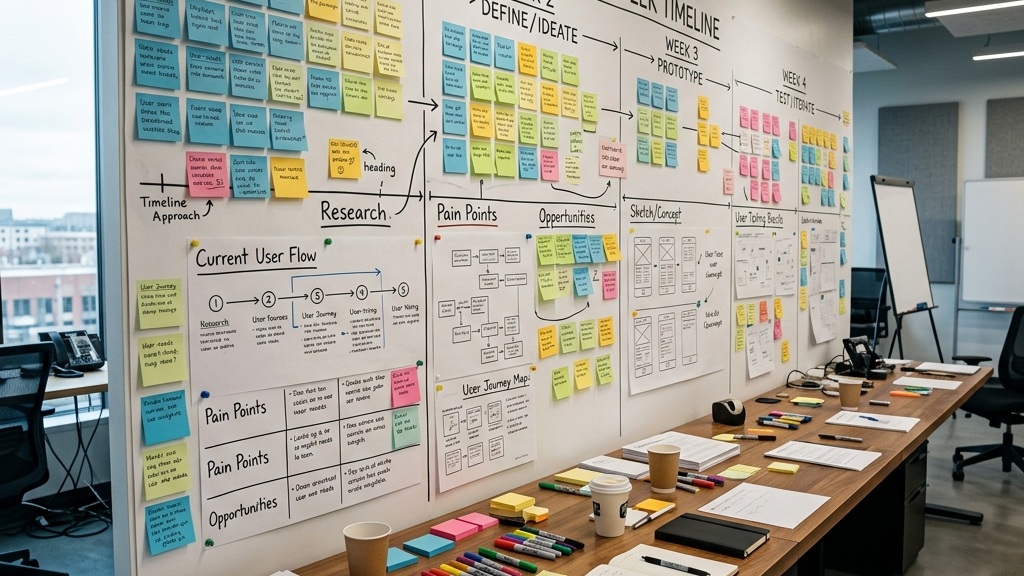
A standard 4-week sprint runs: Week 1 is stakeholder interviews and competitor research, producing a shared Problem Statement. Week 2 builds user personas, journey maps, and a first-draft data model. Week 3 builds the high-fidelity Figma prototype and runs moderated usability testing with real target users. Week 4 locks the technical architecture and runs a MoSCoW backlog prioritization workshop, ending with a signed-off blueprint and a fixed-scope statement of work. Ask to see Week 1’s Problem Statement next to Week 4’s Architecture Blueprint – if the blueprint doesn’t visibly trace back to specific interview and usability findings, the Discovery was theater, not research.
What are Marty Cagan’s “four big risks” and how does a Discovery phase actually address each one? [Scenario: CTO or CEO vetting whether a proposed Discovery scope is complete]
Marty Cagan of the Silicon Valley Product Group defines four risks every product idea carries until validated: value risk (will users choose it or customers pay for it), usability risk (can users figure out how to use it), feasibility risk (can engineers build it with the time and tech available), and business viability risk [does it work for sales, legal, compliance, and unit economics]. A complete Discovery phase retires each one with a specific deliverable: personas and journey maps address value risk, the interactive prototype and its usability testing address usability risk, the architecture blueprint addresses feasibility risk, and the MoSCoW-prioritized backlog – reviewed with a commercial stakeholder, not just engineers – addresses business viability risk. The most common gap in outsourced Discovery is business viability, since it requires someone with commercial authority in the room rather than technical staff alone; ask your agency directly who owns that risk before signing.
Suggested Posts








How useful was this post?
Share it with your friends


Get our latest articles here!
Thank you for subscribing to our blog!
Do you have any questions?
Help us improve the content of this Insightful blog by asking us questions. Manifera's team of experts will help you answer these questions as soon as possible.
