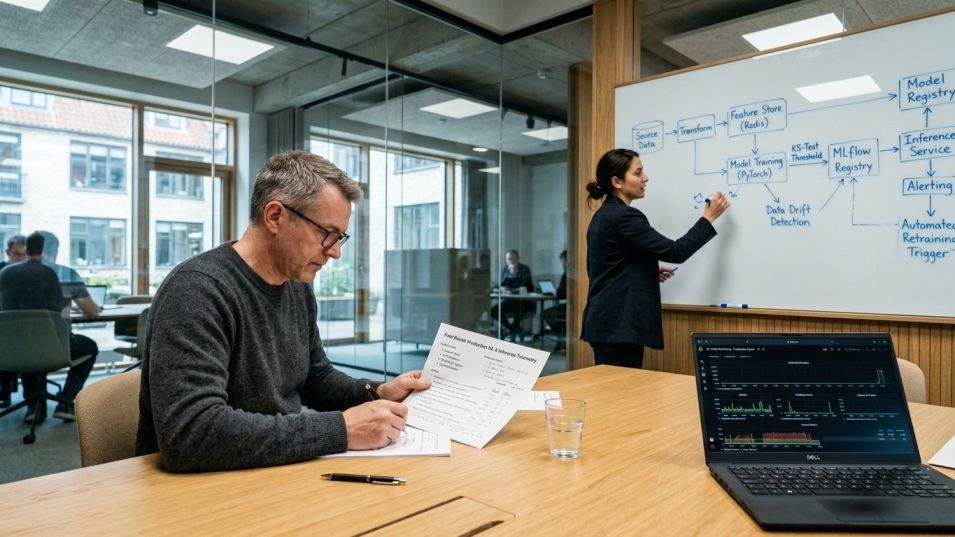
More candidates than most hiring managers would like to admit can talk fluently about transformers, embeddings, and RAG pipelines for forty-five minutes and never once mention what happens when the model’s inputs drift six weeks after launch. That gap – between vocabulary and production experience – is exactly what a well-run final interview is supposed to catch, and it’s exactly what most final interviews fail to catch when hiring AI developers. If you’re the person signing off on the offer, the questions you ask in that last round determine whether you get an engineer who has actually operated a model under real traffic, or one who has only ever demoed it to a friendly panel.
This matters more at the decision stage than anywhere else in the hiring funnel. By the time a candidate reaches your final interview, they’ve already survived a resume screen and at least one technical round. They know the buzzwords. What you haven’t yet confirmed is whether they’ve lived through the unglamorous parts of running AI in production: monitoring, retraining triggers, cost control, and the moment a model starts confidently producing wrong answers. This guide gives you a repeatable framework – seven final-round questions, in sequence – built specifically to surface that experience or expose its absence.
Why Most Final-Round Interviews Miss This
The standard technical interview for AI developers over-indexes on algorithmic fluency: can the candidate explain attention mechanisms, discuss fine-tuning strategies, or whiteboard a neural network architecture. Those are legitimate signals of academic and conceptual grounding, but they say almost nothing about whether someone can keep a model healthy in a live system serving paying customers. A candidate can pass every conceptual question and still have never watched a model’s precision quietly degrade over a three-month window, never debugged a silent data pipeline failure at 2 a.m., or never had to justify an inference bill to a finance team.
The fix isn’t a harder algorithms round. It’s a shift in what the final interview is designed to detect. Instead of asking candidates to describe AI concepts, ask them to narrate specific production incidents – the kind that only happen after a model has been live for months, not days. Vague or generic answers to these questions are the clearest disqualifying signal you’ll get in the entire hiring process, more reliable than any take-home assignment.
The Framework: 7 Questions That Separate Production Engineers From Portfolio Builders
1. “Walk me through the last time a model of yours degraded in production – how did you find out, and what fixed it?”
This is the single most revealing question you can ask. A candidate with real experience will answer with specifics: a monitoring dashboard that flagged rising latency or falling confidence scores, a support ticket spike that preceded any alert firing, or a scheduled evaluation job that caught drift before customers noticed. They’ll describe a root cause – stale training data, an upstream schema change, a shift in user behavior – and a concrete remediation, not just “we retrained it.” A candidate who has only built models in notebooks will pivot to describing hypothetical degradation scenarios in the abstract, because they have none to recall.
2. “What does your retraining trigger actually look like – calendar-based, metric-based, or manual?”
Production AI developers have opinions here because they’ve had to defend a retraining cadence to a budget owner. Listen for whether they can articulate the tradeoff between retraining too often (cost, instability) and too rarely (drift, stale personalization). A strong answer names the specific metric that triggers a retrain – a drop in F1 score below a threshold, a rise in customer escalations tied to model output, or a scheduled quarterly refresh paired with ad hoc triggers for known seasonal shifts.
3. “Tell me about a time you had to say no to a stakeholder who wanted a model shipped faster than you thought was safe.”
This question tests judgment under commercial pressure, which is where a surprising number of “AI developers” reveal they’ve never actually owned a production decision. Listen for a story with real stakes: a product manager pushing for launch before a bias audit was complete, a sales deadline colliding with insufficient test coverage on edge cases. The candidate should describe how they made the case – with data, not just an opinion – and what the actual outcome was, including any compromise reached.
4. “How do you monitor for silent failures – cases where the model returns a confident, plausible, wrong answer?”
This is the failure mode that separates AI systems from traditional software, where a crash is usually obvious. A candidate with real production time will describe techniques like confidence-score thresholding, human-in-the-loop sampling for high-stakes outputs, shadow deployments that compare a new model’s outputs against the old one before cutover, or automated evaluation sets that get re-run against every model version. If the answer stops at “we have good test coverage,” probe further – traditional unit tests rarely catch this class of failure.
5. “What was your actual inference cost per request on your last production model, and what did you do to bring it down?”
Cost discipline is a production-only concern; nobody optimizes inference cost in a class project or a hackathon. A candidate who has genuinely operated AI at scale will have a number, even an approximate one, and a story about a specific optimization – batching requests, distilling a smaller model for a subset of traffic, caching common queries, or switching providers for a cost-performance tradeoff. This question also indirectly tests whether they’ve worked cross-functionally with finance or product on unit economics, a maturity signal worth noting.
6. “Describe the worst data quality problem you inherited, and how you diagnosed it wasn’t a model problem.”
Junior and portfolio-only candidates default to blaming or fixing the model when something goes wrong. Experienced engineers know that a large share of production AI failures trace back to upstream data – a broken ETL job, a schema change nobody flagged, duplicated records skewing a distribution. Listen for a diagnostic process, not just a fix: how did they rule out the model itself before spending time retraining something that didn’t need it?
7. “If I called your last team lead right now, what would they say was the one thing you got wrong on a shipped model?”
This closing question does double duty. It tests self-awareness and honesty – candidates who claim a flawless track record on production AI are either inexperienced or not being candid, since every real deployment has at least one lesson learned the hard way. It also gives you a natural, low-friction opening to request a reference check focused specifically on production incidents rather than general performance, which is the reference conversation that actually predicts on-the-job success.
What to Do When the Answers Are Vague
A vague answer to any single question above isn’t automatically disqualifying – nerves and interview format matter. But a pattern across three or more questions, where a candidate consistently redirects to conceptual explanations instead of specific incidents, is a strong signal you’re evaluating a portfolio builder rather than a production operator. At that point, the honest move is either a working session – a paid half-day or full-day trial where the candidate handles a real (sanitized) production scenario alongside your team – or a polite pass, rather than hoping the gap closes on the job at your cost.
This is also where many VPs of Engineering discover that the internal hiring pipeline simply isn’t sourcing candidates with this depth of experience, because production AI talent at this level is scarce and expensive in most European labor markets. That’s a structural problem this framework won’t solve on its own – it will only make the shortage more visible.
A Simple Scoring Rubric You Can Use Today
Turning seven open-ended questions into a defensible hiring decision requires some structure, especially if more than one person is in the room and you need to compare notes afterward without relying on gut feel alone. A rubric doesn’t need to be elaborate to be useful – it needs to force the interviewer to write down evidence, not impressions.
For each of the seven questions, score the candidate on three dimensions: specificity (did they name a real system, metric, or incident, or stay generic), ownership (did they personally make the decision or diagnosis, or were they adjacent to someone else who did), and outcome (can they state what actually happened afterward, including anything that didn’t work). A candidate scoring low on specificity across multiple questions is the single strongest predictor of a portfolio-only background, more reliable than years of experience listed on a CV or the prestige of a previous employer.
It’s worth calibrating this rubric against your own team’s senior engineers before using it on candidates. Ask two or three of your strongest current AI engineers the same seven questions in a low-stakes setting and note how they answer – that calibration run tells you what a genuinely strong answer sounds like in your specific domain, whether that’s fintech fraud models, logistics forecasting, or customer-support automation, and prevents the rubric from drifting into an unrealistic bar that even your best people wouldn’t clear.
One more practical note: run this framework consistently across every final-round candidate, including internal transfers and referrals. It’s tempting to relax the bar for a candidate who came through a trusted referral or an internal team move, but production incidents don’t check where a hire came from, and the framework’s value comes entirely from consistent application.
Where an Offshore Team Changes the Equation
If your internal pipeline keeps surfacing candidates who pass the conceptual round but fail this framework, the fastest fix is often not another recruiting cycle – it’s working with a partner who has already run this exact vetting process at scale. Manifera builds dedicated engineering teams through its offshore software development services, and every engineer proposed for an AI-focused pod has already been screened against production incident history, not just conceptual fluency, before your team ever sees a CV. This is European project governance paired with Southeast Asian engineering talent – Dutch-managed evaluation standards applied to a deep Ho Chi Minh City engineering bench, so the seven questions above are already the bar candidates clear before reaching you.
Communication is the other variable that quietly sinks AI hiring even when the technical vetting is solid. Manifera’s developers are assessed for written and spoken English fluency and have meaningful working-hour overlap with CET, which matters enormously when a production incident needs a real-time conversation, not a 12-hour timezone delay. For teams evaluating whether to build this capability internally or bring in a dedicated pod, our custom software development services page outlines how a scoped AI engagement is typically structured from discovery through delivery. As Gartner has repeatedly noted in its commentary on AI talent risk, the shortage of engineers with genuine production MLOps experience – not just model-building skill – is now a bigger bottleneck for enterprise AI initiatives than compute or data availability.
What Production Experience Costs: Compensation Benchmarks to Calibrate Your Offer
A candidate who clears this framework consistently commands a real premium, and it’s worth knowing the number before you’re negotiating against a competing offer. In most Western European markets, a mid-to-senior AI engineer with genuine production MLOps experience – retraining pipelines, monitoring, cost optimization at scale – commands roughly 15-30% more total compensation than a candidate with comparable years of experience but only conceptual or research-project exposure, and that premium widens further for candidates who can speak fluently to incident response under commercial pressure, the exact skill this framework is built to surface. Budget accordingly before you start interviewing, because anchoring your offer to a “generic AI engineer” salary band and then discovering mid-negotiation that your top candidate clears every question in this framework is a common, avoidable way to lose a strong hire over a compensation gap that should have been priced in from the start.
This is also the specific economic case for a dedicated offshore pod rather than individual EU hires for teams that can’t absorb that premium repeatedly across multiple headcount: a Ho Chi Minh City-based AI engineering team, pre-screened against this exact production-incident framework, typically delivers comparable production-readiness at a materially lower blended cost than sourcing and retaining the equivalent seniority individually in Amsterdam, Berlin, or London, without the multi-month sourcing cycle a scarce specialist search usually requires.
Put the Framework to Work Before Your Next Offer
The cost of a bad AI hire is rarely visible until months in, when a model quietly degrades and nobody on the team recognizes the symptoms because nobody has actually operated one before. Run the seven questions above in your next final round, and pay closest attention not to whether candidates know the terminology, but to whether they can narrate a specific incident with a beginning, a diagnosis, and an outcome.
If your last three final-round interviews all produced the same vague, conceptual answers to these questions, that’s a sourcing problem, not an interviewing problem – and it’s worth solving before you extend another offer. Talk to one of our senior architects about your specific challenge, and we’ll walk through what a vetted, production-tested AI engineering pod would look like for your roadmap.
FAQs
What is the biggest red flag when interviewing AI developers for a production role?
The clearest red flag is a candidate who can only describe AI concepts in the abstract and cannot narrate a specific production incident with a beginning, diagnosis, and resolution. Real production experience produces stories with concrete details – dashboards, thresholds, root causes – while portfolio-only experience produces generalities. A pattern of vague answers across three or more incident-based questions is a stronger signal than any single missed question.
How many final-round interview questions should I ask AI developer candidates?
Five to seven focused, incident-based questions are usually enough to distinguish production experience from conceptual knowledge, provided each question asks for a specific story rather than a definition. Adding more questions rarely improves signal quality and often just extends interview fatigue for both sides. Depth on fewer questions beats breadth across many.
Should I still hire an AI developer who gives vague answers but has strong academic credentials?
Strong academic credentials indicate a solid conceptual foundation but do not substitute for production experience, especially for roles where the model will directly affect customers or revenue. Consider a paid trial project or a structured mentorship pairing with a senior production engineer rather than a full unsupervised hire. The right call depends on how much production risk your team can absorb while that gap closes.
How does timezone overlap affect hiring AI developers for a distributed team?
AI production incidents often require real-time collaboration between the engineer, product owner, and sometimes customer support, so a large timezone gap can turn a 20-minute fix into a next-day fix. Teams working with GMT+7 partners typically get four to five hours of overlap with Central European Time, which is enough for live incident response during the workday. This is one reason communication fluency and working-hour overlap should be evaluated alongside technical skill.
Is it better to hire individual AI developers or bring in a pre-vetted dedicated team?
Individual hires give you more control over day-to-day direction but put the full burden of technical vetting, onboarding, and retention on your internal team. A pre-vetted dedicated team from an established offshore partner arrives with production-experience screening already completed and can typically scale up or down within two to four weeks as project needs change. The right choice depends on whether your priority is long-term ownership or speed to a working, production-tested team.
(Scenario: candidate’s portfolio is mostly personal GitHub projects, not employer work) How much weight should a strong personal GitHub portfolio get if the candidate lacks employer-backed production experience?
A polished personal portfolio demonstrates initiative and conceptual skill but rarely exposes a candidate to the commercial pressures this framework is designed to test, since side projects don’t usually carry a finance team asking about inference cost or a support team escalating a silent failure. Weight it as a positive secondary signal, not a substitute for a direct answer to the seven production questions above.
(Scenario: deciding whether to include a take-home coding assignment in the AI hiring process) Should a take-home assignment be part of the process for a senior AI developer role?
A take-home assignment is more useful for testing raw implementation skill than production judgment, so keep it short and pair it with, rather than instead of, the incident-based interview questions above. If you do include one, design it to require a monitoring or failure-handling component, not just a working model, since that’s the part portfolio-only candidates consistently skip.
(Scenario: candidate’s background is a well-known AI research lab, not a product company) Does experience at a prestigious AI research lab guarantee production readiness?
Not automatically – research lab work often optimizes for model performance on a benchmark rather than reliability, cost, and monitoring under real user traffic, which are distinct skills. Ask the same seven questions regardless of pedigree, since a research background can mask the exact production gap this framework exists to catch.
(Scenario: two interviewers score the same candidate very differently on the rubric) How should we resolve disagreement between interviewers using the scoring rubric?
Have both interviewers cite the specific evidence – the exact quote or detail from the candidate’s answer – that drove their specificity, ownership, and outcome scores, rather than defaulting to a averaged number. A disagreement usually traces back to one interviewer accepting a vaguer answer than the rubric’s evidence standard allows, and surfacing the actual quote resolves it faster than re-debating impressions.
Suggested Posts







How useful was this post?
Share it with your friends


Get our latest articles here!
Thank you for subscribing to our blog!
Do you have any questions?
Help us improve the content of this Insightful blog by asking us questions. Manifera's team of experts will help you answer these questions as soon as possible.