

Traditional “throw-it-over-the-wall” software outsourcing is dead.
For Multinational Corporations (MNCs) and large enterprises dealing with legacy systems, handing a massive PDF of requirements to a vendor and praying for a functional product six months later is an unacceptable risk. When you are modernizing core banking software or a global logistics ERP, you cannot afford to lose control of your architecture.
The modern solution to the IT talent shortage is co development software (often referred to as IT Team Augmentation or Hybrid Engineering).
The data backs up this shift away from the old model. Deloitte’s 2025 Global Business Services Survey found that 78% of organizations now leverage Global In-house Centres or integrated delivery arrangements rather than arm’s-length outsourcing, and that contractors, outsourced teams, and other third-party workers are increasingly formally counted as part of the overall workforce – a level of integration that “throw-it-over-the-wall” outsourcing was never designed to support.
Deloitte’s separate 2024 Global Outsourcing Survey shows the underlying driver has changed too: in 2020, 70% of organizations cited cost savings as their primary reason for engaging external talent; by 2024, only 34% still ranked cost first, with skilled talent access and delivery agility taking over as the leading drivers.
If you are an IT Manager struggling to scale your internal engineering capacity, this guide explains why offshore software development must evolve into a co-development partnership.
1. What is Co Development Software?
In traditional outsourcing, the vendor takes complete ownership of the project execution. They operate in a silo.
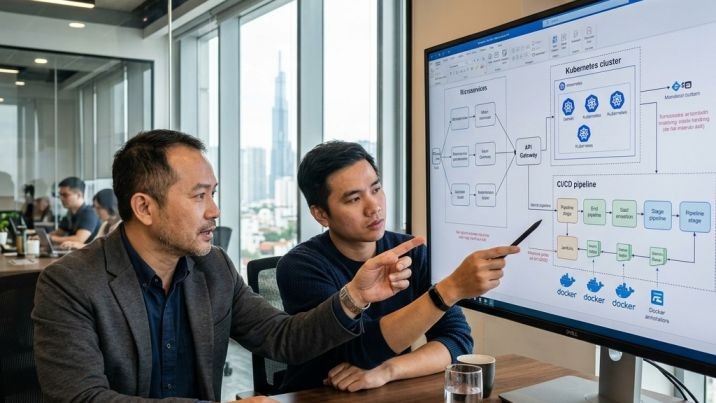
In a co-development model, the vendor provides elite, pre-vetted engineers who physically (or virtually) integrate directly into your existing internal Agile teams.
- You act as the Product Owner.
- Your internal Senior Architect defines the system architecture.
- The co-development engineers work inside your Jira board, commit code to your GitHub repositories, and attend your daily standups.
2. The Core Benefits of Co-Development
Why are MNCs shifting to this model?
1. Absolute Architectural Control: You do not have to worry about the vendor using outdated frameworks or building “black box” code. Because the co-developers work under the supervision of your internal Tech Leads, they adhere strictly to your corporate coding standards and CI/CD pipelines.
2. Zero Vendor Lock-in: Since the code is committed daily to your internal repositories, the intellectual property (IP) is unconditionally yours. If the engagement ends, the knowledge and the code remain seamlessly within your organization.
3. Agile Elasticity: Hiring an internal Senior React Developer in Amsterdam or London takes 4 to 6 months. A custom software development partner offering a co-development model can spin up a dedicated pod of three elite React developers in 2 to 4 weeks.
3. How to Make Co-Development Work (The Security Protocol)
Integrating external engineers into your core enterprise systems requires strict security protocols to prevent data breaches or compliance violations (such as GDPR or SOC2).
The Zero-Trust Integration Checklist:
- VDI (Virtual Desktop Infrastructure): External developers should never download your proprietary source code to their physical laptops. Enforce the use of Cloud Development Environments (e.g., GitHub Codespaces or AWS WorkSpaces).
- Identity and Access Management (IAM): Use Role-Based Access Control (RBAC). The co-development team should only have access to the specific microservices they are actively building. They must never have root access to production AWS environments.
- Data Obfuscation: The co-development team must develop against staging databases populated entirely with synthetic, AI-generated data. They must never interact with live Customer PII (Personally Identifiable Information).
Commercial Models: How Co-Development Engagements Are Priced
IT Managers evaluating co-development often get quoted three fundamentally different commercial structures, and conflating them is the single most common budgeting mistake in enterprise procurement.
Time & Materials (T&M): You are billed for actual hours logged, typically at a blended hourly rate of €35–€55 for a senior offshore engineer working under Dutch Tech Lead supervision. T&M suits discovery-phase work or unpredictable scopes – refactoring a legacy monolith, for example – where the exact task list cannot be defined upfront. The risk: without disciplined sprint reporting, T&M invoices become difficult to reconcile against delivered value.
Dedicated Team (Seat-Based Retainer): You pay a fixed monthly fee per engineer – typically €4,500–€6,500 all-in for a senior full-stack developer, inclusive of the Dutch/European Tech Lead oversight layer, HR overhead, and infrastructure. This is the dominant model for co-development because it mirrors how you already budget for an internal FTE (Full-Time Equivalent), making it trivial to compare against the cost of hiring locally.
Contracts should specify a “bench guarantee”: if an assigned engineer underperforms or is a poor cultural fit, the vendor must replace them within 5 business days at no additional cost.
Outcome-Based Sprints: A smaller subset of engagements price by delivered, accepted story points per two-week sprint rather than hours or seats. This shifts execution risk onto the vendor, but it only works when your Product Owner can write unambiguous acceptance criteria – it is unsuitable for exploratory R&D.
The Day-Rate Arbitrage Trap: Be wary of quotes that look 30-40% cheaper than the market rates above. This usually signals the vendor is staffing your pod with junior engineers billed at a senior rate, or omitting the management and QA overhead entirely – meaning the “co-development” pod is, in practice, unsupervised outsourcing wearing a different label. Always ask for the CVs and seniority breakdown behind the blended rate before signing.
Common Pitfalls That Sink Co-Development Engagements
Even with the right contract in place, co-development fails operationally more often than it fails commercially. Four patterns account for most engagements we’ve seen enterprises walk back from:
1. The Tech Lead Vacuum. If your organization does not assign a dedicated internal Senior Architect to review pull requests and own architectural decisions, the external pod fills that vacuum by default – and you end up with the exact “black box” outcome co-development was supposed to prevent. Co-development requires active internal governance, not passive oversight.
2. Insufficient Overlap Windows. Amsterdam (CET) and Ho Chi Minh City (ICT, UTC+7) have a 5-6 hour offset depending on daylight saving. Engagements that don’t deliberately schedule a synchronous overlap block – typically 14:00–18:00 CET / 19:00–23:00 ICT – end up running entirely on asynchronous Slack messages and next-day code reviews, which quietly doubles the time it takes to resolve any ambiguity in a ticket.
3. Ticket Ambiguity. User stories written as one-line titles without explicit acceptance criteria force external engineers to guess at intent. Because they are not in the room for informal hallway conversations, gaps that an internal hire might resolve by asking a colleague instead get built exactly as literally specified – and rejected at review, burning a sprint.
4. Second-Class Citizen Syndrome. Excluding the co-development pod from sprint planning, retrospectives, or roadmap discussions – treating them as ticket-takers rather than team members – measurably increases attrition on the vendor side and erodes the sense of ownership that makes co-development superior to outsourcing in the first place.
The fix for all four is procedural, not technical: a written Definition of Ready (what a ticket must contain before it enters a sprint) and Definition of Done (what “complete” means, including test coverage and documentation), plus a mandatory daily overlap window baked into both sides’ calendars from day one.
Co-Development vs. Staff Augmentation vs. Managed Services: Which One Do You Actually Need?
IT Managers frequently use “co-development,” “staff augmentation,” and “managed services” interchangeably in vendor conversations, and vendors rarely correct the confusion because all three are profitable to sell.
They are not the same engagement, and picking the wrong one is a more common cause of enterprise IT sourcing regret than picking the wrong vendor. The industry itself is mid-shift on this point: sourcing advisory Everest Group’s 2025 assessments of contingent talent providers note that the market is rapidly transitioning away from pure staff augmentation toward managed-services models, precisely because plain body-shop staffing so often leaves the governance gap described earlier in this article.
The practical decision rule: if you have a strong internal Tech Lead and want the external engineers embedded in your process, co-development is the right model – it is what the rest of this article describes. If you do not have that internal capacity and are willing to cede implementation control in exchange for outcome accountability, a managed service is more honest about what you are actually buying.
Staff augmentation alone, without either strong internal governance or a managed-service SLA backing it, is the configuration most likely to quietly degrade into the “black box” outcome described in the pitfalls section above – you get bodies, not a partnership, and you inherit 100% of the delivery risk without gaining the architectural control that justified going external in the first place.
4. The Manifera Co-Development Hub
At Manifera, we specialize in building highly secure co-development teams for European enterprises.
Our Hub-and-Spoke model is uniquely positioned for this. Our Dutch management layer ensures that our Dedicated Teams in Vietnam undergo rigorous background checks, ISO 27001 compliance training, and possess the English fluency required to integrate seamlessly into your daily European Scrum ceremonies.
We do not just give you “resource bodies.” We provide disciplined engineering pods that scale your internal velocity from Day 1.
FAQs
What is the difference between Co-Development and Traditional Outsourcing?
Traditional outsourcing involves handing an entire project to an external vendor who builds it in isolation. Co-development (or team augmentation) involves integrating external engineers directly into your internal team, where they work under your direct management and within your own repositories.
Is Co-Development suitable for building a product from scratch?
It can be, provided you have a strong internal Product Owner and Lead Architect to guide the external team. However, if you lack internal technical leadership, it is usually safer to hire an agency to manage the entire project lifecycle (Full Custom Software Development).
How quickly can a Co-Development team be scaled up?
Unlike traditional hiring, which can take months, a professional co-development partner can usually provide a dedicated pod of vetted, senior engineers within 2 to 4 weeks.
How do I protect my company’s data when using external co-developers?
You must enforce strict “Zero Trust” protocols. This includes using Cloud Development Environments (so code is never downloaded locally), implementing Role-Based Access Control (RBAC) in your Git repositories, and ensuring they only test against synthetic dummy data, never live production PII.
Why do European companies prefer Southeast Asian engineers for Co-Development?
Southeast Asia (particularly Vietnam) offers a massive, highly educated talent pool of software engineers who are experienced in modern cloud architectures. When managed via a European Hub to mitigate time-zone and cultural friction, they provide elite technical execution at a highly sustainable economic rate.
What pricing model should I use for a Co-Development engagement?
Match the model to the certainty of your scope. Use Time & Materials for open-ended discovery or legacy refactoring, a Dedicated Team retainer (the most common choice) when you need predictable, FTE-equivalent budgeting, and Outcome-Based Sprints only when your Product Owner can write precise, unambiguous acceptance criteria.
What is the single biggest reason Co-Development engagements fail?
Lack of active internal governance. If no internal Senior Architect is assigned to review pull requests and own architectural decisions, the external pod fills that vacuum by default, recreating the exact “black box” outcome co-development is meant to prevent.
What is the difference between Co-Development, Staff Augmentation, and a Managed Service?
Staff augmentation fills headcount gaps under your direct, individual supervision – you own all delivery risk. Co-development embeds vetted external engineers into your existing team and process while your internal Tech Lead retains architectural control, with delivery risk shared. A managed service hands an entire, well-scoped system to the vendor, who owns implementation and delivery risk against SLA-backed outcomes while you manage the contract, not the day-to-day team. Choose based on whether you have strong internal technical governance (co-development) or want to cede implementation control entirely in exchange for outcome accountability (managed service).
Suggested Posts







How useful was this post?
Share it with your friends


Get our latest articles here!
Thank you for subscribing to our blog!
Do you have any questions?
Help us improve the content of this Insightful blog by asking us questions. Manifera's team of experts will help you answer these questions as soon as possible.
