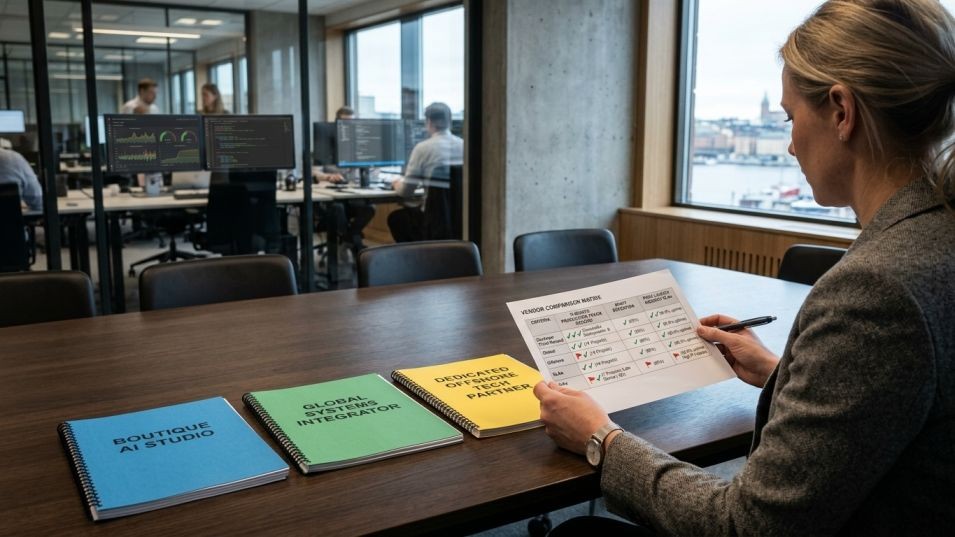
It’s commonly assumed that a polished AI demo is evidence of production capability. It isn’t. Demos are cheap to make impressive – a curated dataset, a rehearsed walkthrough, a chart that only ever shows the good months. What actually separates a vendor with real production experience from one selling a convincing prototype rarely shows up on screen at all; it shows up in a single reference call, or in what a “flagship AI project” case study conveniently leaves out about how long the project actually ran before quietly stalling in pilot.
This is the trap that catches most IT Managers evaluating AI software development vendors at the final decision stage: demos are cheap to make impressive, and marketing case studies rarely disclose whether a project actually reached sustained production use. If you’re down to a shortlist and need a way to compare vendors on substance rather than polish, this guide walks through three common vendor archetypes, the questions that expose the gap between demo and production reality, and where each archetype tends to fall short.
The Three Vendor Archetypes You’re Likely Comparing
Most AI software development shortlists end up with some mix of three archetypes, and each has a distinct failure mode worth understanding before you sign anything.
The Boutique AI Studio typically consists of a small team of highly credentialed data scientists, often with strong academic or research backgrounds. Their demos are usually the most technically impressive of the three, because the team is optimized for model performance on a benchmark, not for the unglamorous work of production hardening. The failure mode here is a model that performs beautifully in a controlled evaluation and then struggles with the messiness of real production data, inconsistent uptime requirements, or the DevOps maturity needed to keep a model healthy after handoff.
The Enterprise Systems Integrator brings scale, established compliance processes, and a long client roster, which can be reassuring for regulated industries. The tradeoff is usually cost and speed: large SIs frequently staff AI projects with a thin layer of senior expertise sitting on top of a much larger junior delivery team, and project timelines can stretch well beyond what a smaller, more focused partner would need for the same scope. Their case studies are real, but the specific team that delivered the referenced project is often not the team you’ll actually get.
The Dedicated Offshore Development Partner offers a middle path: a named, stable team assigned to your project specifically, with cost efficiency closer to the boutique studio than the enterprise SI, but without the large SI’s compliance overhead built in by default. The risk here is variability in quality between providers – this category has the widest range of actual capability, which makes the verification questions below more important for this archetype than either of the other two.
Head-to-Head: What Actually Predicts Production Success
Verifiable Deployment History vs. Case Study Claims
Ask every vendor for a reference client whose AI system has been in production for at least twelve months, not their most recent or most polished project. A vendor with genuine production experience will have several to choose from and will readily connect you with a reference who can speak to post-launch reality – retraining cadence, incident history, and total cost of ownership. A vendor whose best answer is a project still in pilot, or a reference who can only speak to the initial launch and not what happened afterward, is showing you their demo-to-production gap directly.
Team Composition: Named Individuals vs. “Access to Experts”
The Boutique AI Studio and Enterprise SI both tend to sell access to their most credentialed people during the sales process, then staff the actual engagement differently. Ask for the specific names, seniority levels, and percentage-time allocation of the people who will work on your project, and get it in writing as part of the proposal. A vendor confident in its actual delivery team will provide this without resistance; a vendor that hedges is telling you something about the gap between who sold you and who will build for you.
MLOps Maturity, Not Just Model Accuracy
Model accuracy on a validation set is table stakes and tells you almost nothing about production readiness. Ask each vendor to describe their standard approach to model monitoring, drift detection, and retraining triggers for a project like yours, in specific technical terms. Vendors with genuine production experience will discuss it fluently and unprompted; vendors without it will redirect the conversation back to accuracy metrics, because that’s the part of the AI lifecycle their team has actually practiced.
Cost Transparency Over the Full Lifecycle
Compare quotes not just on initial build cost but on the ongoing cost of monitoring, retraining, and inference at your expected production volume. A vendor that only prices the initial build is either inexperienced with the full AI lifecycle or is deliberately structuring the quote to win the initial deal and negotiate the expensive ongoing costs later. Ask for a 12-month total cost of ownership estimate as part of the final proposal, not just a project quote.
Where a Dedicated Team Model Closes the Gap
The Dedicated Offshore Development Partner archetype, when properly vetted against the criteria above, tends to resolve the two most common failure modes of the other two options: the Boutique Studio’s production-hardening gap and the Enterprise SI’s cost-and-speed mismatch. Manifera operates its AI engagements through the same custom software development delivery model used across its 160-plus delivered projects for 120-plus clients globally, which means the production discipline – CI/CD, monitoring, structured handoff – is baked into the process rather than bolted on after a research-focused build.
For IT Managers specifically weighing this against building an internal capability, our offshore software development model provides a named, stable team with disclosed seniority levels from the proposal stage, which directly answers the team-composition verification point above. Communication is also a frequent point of failure in AI vendor relationships specifically because AI projects require more iterative, technical back-and-forth than a typical feature build – Manifera’s engineers are assessed for English fluency and maintain four to five hours of daily overlap with Central European Time, which matters when a drift alert needs a same-day conversation rather than a next-day email thread.
Red Flags That Surface During Proposal Negotiation
Beyond the four verification questions above, the negotiation phase itself tends to surface useful signal, if you know what to watch for. A vendor that resists putting named team members and seniority levels into the contract itself – insisting instead on a verbal assurance during the sales call – is telling you that the team you meet during procurement may not be the team that shows up on day one of the engagement. This is a more common practice than most IT Managers expect, particularly among Enterprise Systems Integrators managing multiple concurrent client relationships with a shared pool of senior staff stretched across all of them.
Watch also for how a vendor responds when you ask to speak with the engineer who will actually write the production code, rather than only the account manager or solutions architect who ran the sales process. A Boutique AI Studio confident in its bench will typically make this introduction happily, since it reinforces their pitch. A vendor that keeps redirecting you back to the same one or two client-facing personnel across multiple conversations may be signaling that the technical bench is thinner than the proposal implies.
Payment structure is another underrated signal. Vendors with genuine confidence in their production track record are usually comfortable tying a portion of payment to post-launch stability metrics – for example, a holdback released after 90 days of the model meeting agreed accuracy and uptime thresholds in production, not just after initial deployment. A vendor that insists on full payment at go-live with no post-launch accountability built in is shifting all of the production risk onto you, which is precisely the risk this entire evaluation exercise is meant to price in before you sign.
What a Strong Proposal Actually Looks Like
A proposal that has genuinely internalized the production-first mindset described throughout this comparison tends to share a few concrete characteristics regardless of which vendor archetype it comes from. It names the specific engineers assigned to the work, including their seniority level and percentage allocation, rather than describing a generic “senior team.” It includes a dedicated section on monitoring, drift detection, and retraining cadence with specific tooling named, not just a vague commitment to “ongoing support.” It separates initial build cost from a realistic 12-month operating cost estimate, so you’re comparing full lifecycle economics rather than headline day rates. And it references at least one production deployment older than twelve months, with a reference contact willing to discuss what actually happened after launch, including anything that didn’t go to plan.
If a proposal on your desk right now is missing two or more of these four elements, that’s worth raising directly with the vendor before moving forward – a vendor with genuine production maturity will have ready answers, while a demo-driven vendor will often need to go back and construct them after the fact, which itself tells you something.
A Practical Scoring Table for Your Shortlist
AI vendor archetypes scored on production evidence:
Use this table as a starting point in your own vendor scorecard, filling in each cell with what you actually learn from reference calls rather than what the sales deck claims. In practice, the gap between a vendor’s marketed capability and its delivered capability is one of the most common reasons enterprise AI initiatives stall, and it is usually harder to see than the underlying technical difficulty of the AI itself.
The Reference Call Script That Gets Past the Rehearsed Answer
Every vendor hands you their best reference, so the value of the call depends entirely on which questions you ask, not on whether you make the call at all. Skip “were you happy with the project” – it invites a rehearsed yes – and ask instead: “What was the single worst week of this engagement, and how did the vendor handle it?” A genuine reference will have a specific answer within seconds; a coached one will pause and reach for something generic like “communication could always be better.” Follow with “how many people from the original proposal are still on the account today?” since team turnover on the reference’s own project is a leading indicator of what will likely happen on yours. Finally, ask directly, “would you sign with them again knowing what you know now?” – a hesitant or qualified yes is far more informative than an enthusiastic one, because it usually surfaces the one caveat the reference was trying to be diplomatic about.
If a vendor can only produce one reference willing to take an unscripted call, or insists on joining the call themselves “to help answer technical questions,” treat that as a data point on its own – a vendor with a genuinely strong production track record has multiple clients willing to speak candidly without supervision.
Making the Final Call
By the decision stage, you’ve already filtered out vendors on basic fit. What separates a good final choice from a costly mistake is verifying production reality rather than demo polish, and the four questions above – deployment history, team composition, MLOps maturity, and full lifecycle cost – will surface that reality faster than any additional round of technical demos. Run your remaining shortlist through this scorecard before signing, and treat any vendor’s resistance to answering these specific questions as data in itself.
It also helps to involve more than one internal stakeholder in this final verification round. A procurement lead evaluating contract terms may miss a technical red flag that your lead engineer would catch immediately during a reference call, and a business sponsor focused on timeline may not think to ask about post-launch cost structure at all. Splitting the four verification areas across two or three people on your side, each pushing hard on their specific area of expertise, tends to surface more actionable signal than a single generalist doing a surface pass across all four.
Finally, resist the temptation to compress this verification step because a deadline is looming. The entire premise of this comparison exercise is that the cost of getting it wrong – a stalled AI initiative discovered nine months in, after budget and internal credibility have already been spent – is dramatically higher than the cost of a few extra days spent on reference calls and proposal scrutiny before signing.
If your shortlist still has gaps after this exercise, or you want a second opinion on a proposal you’ve already received, get a custom team proposal within 48 hours from Manifera’s delivery team, including named seniority levels and a 12-month cost estimate you can compare directly against what’s already on your desk.
FAQs
(Scenario: IT Manager preparing final-round vendor questions) What questions should I ask AI software development vendors before signing a contract?
Ask for a reference client whose AI system has been in production for at least twelve months, the specific named team members who will work on your project with their seniority levels, their standard approach to model monitoring and retraining, and a 12-month total cost of ownership estimate rather than just an initial build quote. Vendors who hedge on any of these are showing you a gap worth investigating further before signing.
(Scenario: shortlisted vendor’s flagship case study looks too polished) How do I verify an AI vendor’s case studies are real production deployments, not pilots?
Ask directly whether the referenced project is still in active production use today, request a reference contact who can speak specifically to post-launch performance, and ask what has changed about the system since the original launch. A genuine production deployment will have a maintenance and iteration history the vendor can describe in detail; a stalled pilot usually cannot.
(Scenario: shortlist split between a boutique studio and a large SI) Is a boutique AI studio or a larger systems integrator better for production AI work?
Neither is inherently better – boutique studios tend to excel at model performance but sometimes lack production-hardening discipline, while large systems integrators bring process maturity but often at higher cost and with less senior staffing than their sales process suggested. The deciding factor should be which specific gap matters most for your project and how well each vendor answers the verification questions in this guide.
(Scenario: finance asks for the full AI budget, not just the build) How much does ongoing AI model maintenance typically add to the initial development cost?
Ongoing maintenance, monitoring, and periodic retraining for a production AI system commonly add 20-40% of the initial build cost annually, depending on how frequently the underlying data changes and how business-critical the model’s accuracy is. Any vendor proposal that doesn’t address this cost explicitly should be treated as incomplete, not just optimistic.
(Scenario: IT Manager about to sign after a strong demo) What is the biggest mistake IT Managers make when comparing AI development vendors?
The most common mistake is weighting the demo and sales presentation too heavily relative to verifiable production evidence, since a polished demo requires far less organizational maturity than a system that stays healthy in production for a year or more. The second most common mistake is not getting the actual delivery team’s names and seniority levels in writing before signing, which allows a vendor to substitute a less experienced team after the contract is in place.
(Scenario: vendor’s only offered reference gives generic, positive-sounding answers) How do I get honest signal from a vendor-selected reference call instead of a rehearsed testimonial?
Ask specific, hard-to-fake questions like “what was the worst week of this engagement” and “how many people from the original proposal are still on the account today,” rather than general satisfaction questions that invite a rehearsed yes. A vendor that insists on joining the reference call itself, or can only produce one reference willing to speak unsupervised, is itself a signal worth weighing.
(Scenario: draft contract is silent on who owns the trained model and training data after the engagement ends) Who should own the trained model and training data once an AI vendor engagement ends?
Unless explicitly negotiated otherwise, push for the contract to state clearly that you own the trained model weights, the fine-tuned artifacts, and any proprietary training data derived from your business, since a vendor’s default contract template often reserves ambiguous rights over model IP that becomes a real problem if you later switch vendors. Get this in writing before the project starts, not at offboarding.
(Scenario: the specific engineers named in the proposal leave the account mid-engagement) What contractual protection exists against the named engineers leaving partway through the project?
Ask for a contractual commitment to notify you before any named team member is rotated off the account, along with a defined knowledge-transfer period to their replacement, rather than discovering the change only when a different engineer shows up to a standup. A vendor confident in its bench depth and retention will agree to this without much pushback.
(Scenario: comparing quotes from multiple vendors using different currencies and rate structures) How do I compare AI vendor quotes fairly when they use different currencies and pricing structures?
Normalize every quote to a fully loaded cost per engineer-month in a single currency, including any platform, infrastructure, and management fees the headline day rate excludes, rather than comparing headline day rates directly. A lower day rate paired with hidden management overhead or excluded infrastructure costs can end up more expensive than a higher, fully inclusive rate once normalized.
Suggested Posts


How useful was this post?
Share it with your friends


Get our latest articles here!
Thank you for subscribing to our blog!
Do you have any questions?
Help us improve the content of this Insightful blog by asking us questions. Manifera's team of experts will help you answer these questions as soon as possible.