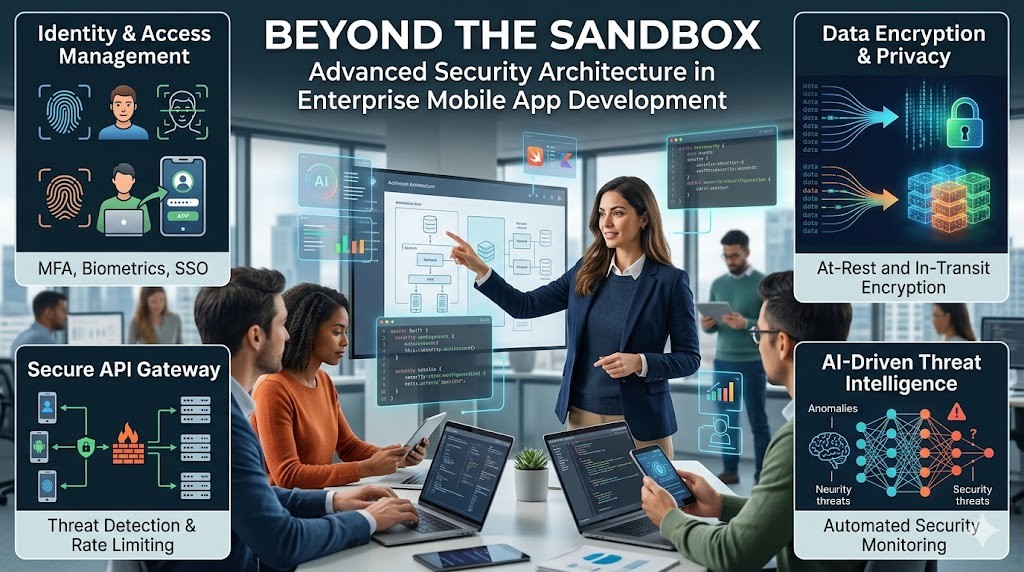
When a consumer downloads a mobile game or a flashlight app, the security stakes are microscopic. If a hacker breaches the app, the worst outcome is an annoying pop-up ad. However, when a B2B enterprise engages in custom mobile app development for its internal workforce or massive corporate clients, the stakes are existential.
Imagine a proprietary mobile application built for a Fortune 500 pharmaceutical company. The app is installed on the iPads of 5,000 field sales representatives and contains highly classified data: clinical trial results, unreleased patent information, and the direct contact details of the top 10,000 prescribing physicians in the country. If an amateur offshore agency builds this app using standard “consumer-grade” architecture, it will be breached. A corporate spy or a state-sponsored hacker will exploit the weak API, steal the entire unreleased patent database, and vaporize billions of dollars in enterprise valuation.
In the realm of high-stakes B2B mobile app development, you cannot rely on Apple and Google to protect you. The App Store “Sandbox” is merely a baseline defense, not a fortress. You must demand that your offshore development center engineers advanced, uncompromising security architectures directly into the physical DNA of the code.
At Manifera, we achieve this by fusing rigorous Dutch management standards with elite Vietnamese software engineers, delivering impenetrable applications through a transparent Agile Scrum framework.
1. Defeating the “Man-in-the-Middle” (SSL Pinning)
The single most terrifying vulnerability in mobile app development is the Man-in-the-Middle (MitM) Attack. When a sales rep connects to a public Wi-Fi network at a coffee shop, they are entering a combat zone. A hacker sitting nearby can create a fake network, intercept the signal to the corporate AWS server, mathematically unwrap standard SSL encryption, and read classified clinical trial data in plain text.
Standard mobile apps rely on the phone’s generic “Trust Store,” which hackers can easily manipulate. To combat this, Manifera’s elite Vietnamese engineers implement SSL Pinning. We hardcode the exact cryptographic fingerprint of the corporate server directly into the app’s binary code. If the app checks the network certificate and they do not perfectly match, the mobile app violently severs the connection, intentionally crashes itself, and refuses to transmit a single byte of data, completely neutralizing the attack.
2. The Local Storage Vault (Hardware-Backed Encryption)
Many enterprise mobile apps need to store data locally so employees can work offline. Amateur developers often save this highly sensitive data in generic storage, like
UserDefaults on iOS or SharedPreferences on Android. This is the equivalent of storing a million dollars in a cardboard box on the sidewalk. If the device is lost, a hacker can easily bypass the lock screen using basic forensic tools and read the entire database.Under strict Dutch management protocols, Manifera mandates deep hardware integration for secure offshore mobile development. On Apple devices, our engineers mathematically force the app to use the Secure Enclave—a physically separate, microscopic silicon vault inside the processor. On Android, we utilize the Android Keystore System. Even if hackers steal the physical iPad and extract the hard drive, the database remains encrypted via SQLCipher. The massive decryption key is physically locked inside the hardware, leaving hackers with nothing but pure, unreadable mathematical garbage.
3. Jailbreak and Root Detection (Runtime Environment Auditing)
What happens if the employee themselves compromises the device? When a phone is “Jailbroken” or “Rooted” to download pirated software, the fundamental security mathematics of the operating system are destroyed. The strict “Sandbox” is ripped open, allowing any cheap malware to reach into your enterprise app’s memory and steal corporate data.
You cannot trust the physical device. Operating within our transparent Agile Scrum cycles, Manifera developers actively inject aggressive Jailbreak/Root Detection algorithms into the mobile app. The exact millisecond the app is opened, it executes a lightning-fast mathematical scan looking for illegal binaries, modified system partitions, or hooked memory spaces. If the app detects a compromised environment, it triggers a “Kill Switch.” It instantly deletes all local corporate data, violently forces a log out, and displays a permanent block screen.
The CTO’s Mandate When you sit down with an offshore software agency to discuss mobile app development, ignore the UI designers and ask to speak to the Lead Mobile Architect. Ask them three questions:
- “How do you implement SSL Pinning in React Native/Flutter?”
- “How do you interact with the Secure Enclave?”
- “What is your protocol for Jailbreak detection on compromised devices?”
If they tell you that “Apple handles security for us,” they are building flashlights, not bank vaults. Terminate the contract and partner with an elite engineering firm like Manifera, where offshore technical excellence guarantees uncompromised enterprise security.
FAQs
Why is standard App Store security insufficient for custom enterprise mobile apps?
Standard security like Apple’s “Sandbox” provides only a baseline defense. B2B enterprise apps often hold highly classified data (like clinical trials or unreleased patents). They require advanced, custom-engineered defense architectures like SSL Pinning and hardware-backed encryption to prevent corporate espionage and massive data breaches.
What is SSL Pinning and how does it protect enterprise data?
SSL Pinning is an elite defense mechanism against Man-in-the-Middle (MitM) attacks. Instead of relying on a device’s generic Trust Store, developers hardcode the specific cryptographic fingerprint of the corporate server directly into the app’s binary. If a hacker tries to intercept the connection, the certificates won’t match perfectly, and the app instantly severs the connection to protect the data.
How does Manifera ensure military-grade security for offshore mobile app development?
Manifera engineers impenetrable mobile apps by fusing rigorous Dutch management standards with elite Vietnamese software engineers. Operating under a transparent Agile Scrum framework, we physically engineer advanced security layers—such as Secure Enclave integration and Runtime Environment Auditing (Kill Switches)—directly into the DNA of your software.
Suggested Posts
How useful was this post?
Share it with your friends


Get our latest articles here!
Thank you for subscribing to our blog!
Do you have any questions?
Help us improve the content of this Insightful blog by asking us questions. Manifera's team of experts will help you answer these questions as soon as possible.