
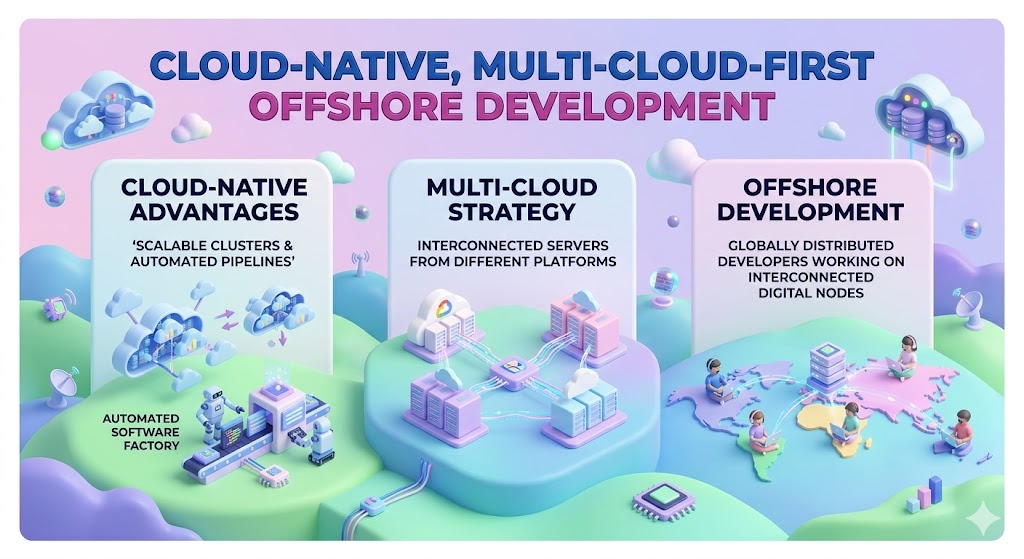
As offshore software development continues to mature, vendors are increasingly standardizing on cloud-native architectures and multi-cloud strategies as a core delivery model rather than a competitive add-on.
In practice, this means offshore teams design and build systems using Kubernetes-based container orchestration and microservices architectures from the outset. Applications are decomposed into independently deployable services, packaged as containers, and managed through standardized Kubernetes clusters. This approach enables teams to scale individual components on demand, deploy updates more frequently, and reduce the blast radius of failures.
Alongside cloud-native design, vendors are adopting a multi-cloud-first strategy. Instead of tightly coupling solutions to a single cloud provider, systems are architected to run across AWS, Azure, and Google Cloud with minimal changes. This improves resilience, as workloads can be distributed or migrated across providers, and increases vendor flexibility, allowing clients to avoid lock-in, optimize costs, and meet regional or regulatory requirements.
By combining cloud-native architectures with multi-cloud strategies, offshore development vendors deliver platforms that are:
-
Highly scalable, supporting rapid growth without major re-architecture
-
More resilient, with improved fault isolation and recovery options
-
Flexible by design, giving clients long-term freedom in cloud and vendor choices
This standardization is becoming the default expectation for modern offshore projects, particularly for clients seeking long-term scalability, operational stability, and strategic control over their technology stack.
Why it’s trending
Cloud-native, multi-cloud-first offshore development is trending because it directly addresses the operational, financial, and strategic pressures organizations face when scaling software globally.
First, cloud-native has become the default architectural expectation, not an innovation initiative. By late 2025, most clients engaging offshore teams assume Kubernetes, microservices, and automated CI/CD as table stakes. Offshore vendors that standardize on these patterns can onboard projects faster, reduce architectural ambiguity, and deliver consistent quality across distributed teams.
Second, multi-cloud strategies respond to growing concerns around vendor lock-in and risk concentration. Enterprises and SMBs alike want the flexibility to shift workloads, negotiate cloud costs, and meet regional compliance requirements. Designing systems to be cloud-agnostic from the start gives clients long-term control while positioning offshore vendors as neutral, trusted partners rather than cloud-specific implementers.
Finally, maturity in offshore delivery models is accelerating adoption. Leading vendors are no longer reinventing architectures per project; instead, they rely on reusable cloud-native reference architectures, governance models, and platform tooling. This industrialization of cloud-native delivery makes multi-cloud offshore execution not only feasible, but efficient and predictable.
Business impact
For businesses, adopting cloud-native, multi-cloud-first offshore development delivers measurable and strategic advantages.
From a scalability perspective, microservices and Kubernetes enable systems to grow incrementally. Organizations can scale individual services without overprovisioning infrastructure, supporting rapid growth while keeping operational costs under control.
In terms of resilience and reliability, cloud-native architectures improve fault isolation and recovery. Combined with multi-cloud deployment options, this reduces the impact of outages and increases overall system availability—critical for customer-facing and revenue-generating platforms.
Vendor flexibility is another key outcome. Clients retain freedom to choose or change cloud providers over time, renegotiate contracts, or expand into new regions without major re-architecture. This flexibility significantly lowers long-term technology risk and strengthens negotiating power.
For offshore development vendors, the impact is equally significant. Standardized cloud-native delivery models:
-
Shorten project ramp-up time
-
Improve cross-team collaboration
-
Reduce rework and architectural debt
-
Enable consistent governance, security, and cost control
Ultimately, cloud-native, multi-cloud-first offshore development shifts the conversation from “where the team is located” to “how effectively the platform is engineered”—making offshore delivery a strategic accelerator rather than a cost-driven compromise.
FAQs
What is cloud-native and multi-cloud-first offshore development?
Cloud-native and multi-cloud-first offshore development refers to the practice where remote software teams build applications specifically designed for cloud environments from the ground up. This approach utilizes services from multiple cloud providers (such as AWS, Azure, and Google Cloud) to ensure flexibility, high availability, and optimal performance.
Why are multi-cloud strategies important for offshore software development?
Adopting a multi-cloud strategy is crucial because it prevents vendor lock-in, enhances disaster recovery capabilities, and allows businesses to optimize their cloud spending. It ensures that offshore development teams can leverage the best-in-class tools from different cloud providers tailored to specific project requirements.
How does Manifera implement cloud-native and multi-cloud solutions?
Manifera implements advanced cloud architectures by fusing rigorous Dutch management standards with highly skilled Vietnamese engineering. Operating transparently under the Agile Scrum framework, our offshore DevOps and development teams ensure secure, scalable, and seamless deployments across multiple cloud platforms.
Suggested Posts


How useful was this post?
Share it with your friends


Get our latest articles here!
Thank you for subscribing to our blog!
Do you have any questions?
Help us improve the content of this Insightful blog by asking us questions. Manifera's team of experts will help you answer these questions as soon as possible.
