
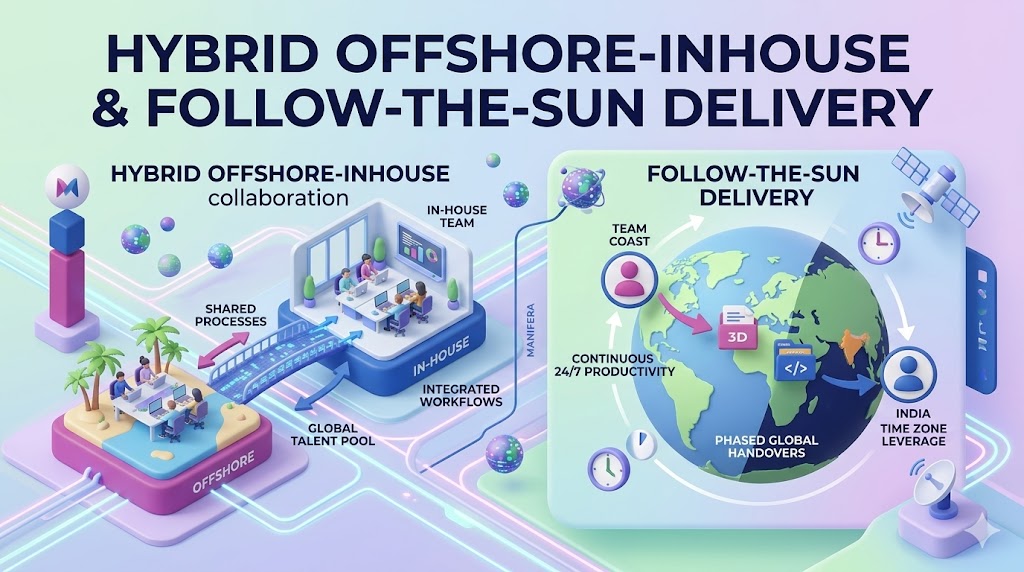
In a world where digital products and services never sleep, traditional development models with a single team working limited hours are increasingly leaving companies behind. To stay competitive, many organizations are turning to hybrid offshore-inhouse models that combine the strengths of local teams with global engineering capabilities — enabling round-the-clock delivery and smoother collaboration across time zones.
A hybrid model allows businesses to strike the right balance: maintaining close strategic alignment through an inhouse core while leveraging dedicated offshore experts to accelerate delivery, increase throughput, and reduce bottlenecks.
What is hybrid offshore-inhouse delivery?
Rather than choosing exclusively between onshore, nearshore, or offshore, the hybrid offshore-inhouse model blends the benefits of both worlds:
A local core team that deeply understands the business context, customer needs, and product strategy.
Offshore teams that extend capacity, provide specialized skills, and support execution — often at a more competitive cost base.
This structure enables flexibility without losing sight of business priorities. Core strategic decisions stay close to home, while execution-oriented tasks such as feature development, automated testing, and maintenance can be distributed globally.
This setup is especially powerful when paired with the follow-the-sun delivery principle — a model in which work seamlessly transitions between time zones, effectively creating a development engine that runs 24/7.
Why follow-the-sun matters
At its heart, follow-the-sun delivery means handing off work at the end of one team’s day to another team in a different time zone. When orchestrated well, this leads to:
Shorter release cycles — work progresses continuously rather than waiting for the next workday.
Faster response times — issues can be addressed by teams waking up to work already in progress.
Greater predictability — overlapping work windows help avoid delays and reduce dependencies.
If you’d like a quick, practical explanation of how follow-the-sun works from an expert perspective, check out this video where Eltjo talks about the principle and how it applies to hybrid delivery.
Better collaboration through structured handoffs
Successful hybrid/offshore models don’t happen by accident. They require deliberate structures that ensure seamless collaboration across locations and time zones.
Key practices include:
Clear documentation and shared workflows – Reducing knowledge gaps when handing over work.
Overlapping time windows – Small shared hours each day for real-time syncs and handoffs.
Unified tooling – Shared project boards, automated pipelines, and real-time communication platforms.
Cultural alignment – Regular cross-team exchanges to build trust and understanding.
These elements help ensure that handoffs are smooth, teams stay aligned with overall goals, and quality doesn’t slip between the cracks.
Hybrid delivery in action
Many companies start with an inhouse team that owns product vision, architectural decisions, and core integrations. As demand grows, they augment capacity with offshore engineering teams focusing on feature implementation, automated testing, and ongoing releases.
This is where a proven delivery partner can make a difference. At Manifera, we work with organizations to set up hybrid teams that are:
Aligned to your product roadmap
Structured for follow-the-sun handoffs
Optimized for continuous delivery
Learn how we help clients scale their development capacity and build resilient delivery pipelines in our overview of offshore software development services.
And if you’re planning how to structure your hybrid setup right from the start, this guide on setting up your offshore team provides practical insights on governance, onboarding, and collaboration patterns.
Hybrid offshore-inhouse models represent a practical evolution for companies that want the best of local control and global execution. When paired with a follow-the-sun mindset and disciplined collaboration practices, they deliver faster outcomes, better continuity, and a more resilient development engine.
In an era where speed and quality are both business imperatives, hybrid delivery isn’t just a cost play — it’s a strategic advantage.
FAQs
What is the hybrid offshore-inhouse software development model?
The hybrid offshore-inhouse model is a collaborative approach where your internal team works seamlessly alongside a dedicated offshore development team. It combines your in-house business expertise with external technical scalability, ensuring high-quality software delivery without the overhead of hiring locally.
How does the “follow-the-sun” delivery model work?
The “follow-the-sun” model strategically leverages time zone differences to create a continuous 24/7 development cycle. While your in-house team rests, your offshore developers continue building, testing, and resolving issues, significantly accelerating the project’s overall time-to-market.
How does Manifera successfully implement hybrid and follow-the-sun models?
Manifera expertly bridges geographical gaps by fusing rigorous Dutch management standards with elite Vietnamese engineering. Operating under a transparent Agile Scrum framework, we establish core overlapping hours for strategic handovers while utilizing the time zone advantage to ensure non-stop, secure custom software development.
Suggested Posts


How useful was this post?
Share it with your friends


Get our latest articles here!
Thank you for subscribing to our blog!
Do you have any questions?
Help us improve the content of this Insightful blog by asking us questions. Manifera's team of experts will help you answer these questions as soon as possible.
